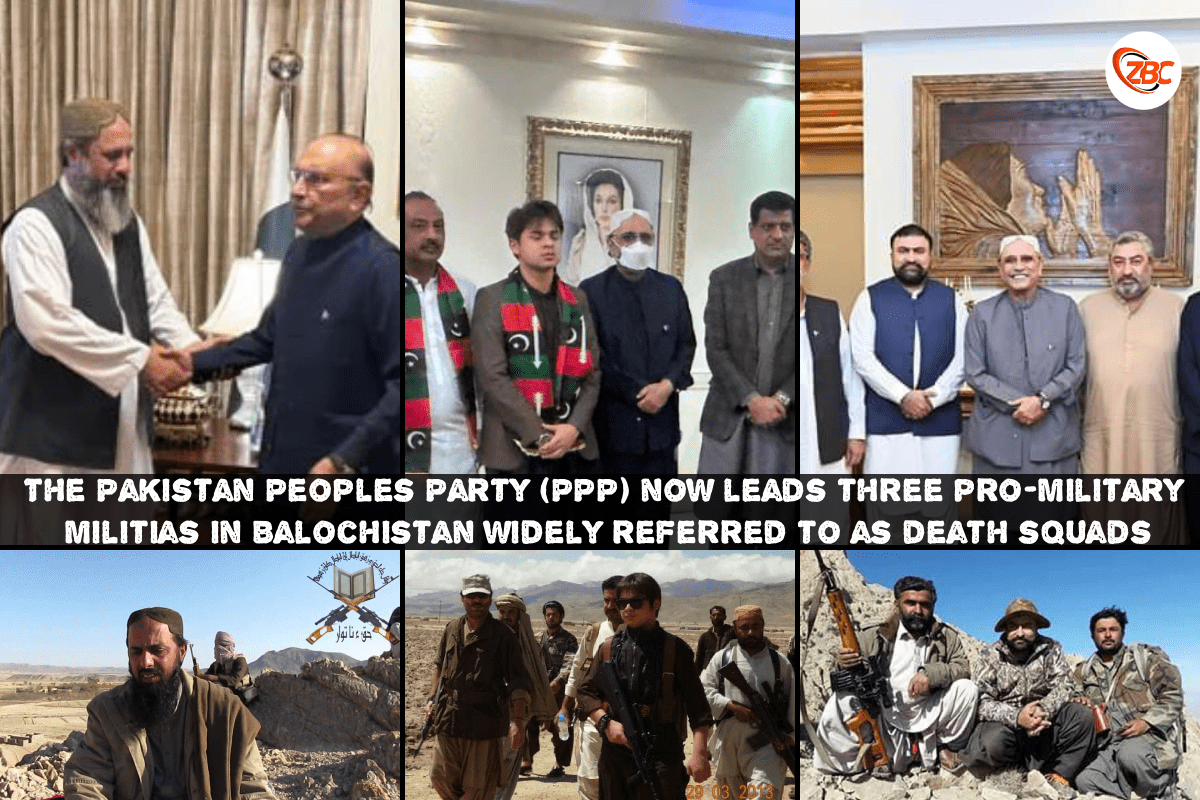
The Pakistan Peoples Party (PPP) now appears to be politically hosting leaders associated with three of the most controversial pro-military militia networks in Balochistan, incorporating them into its political ranks as the province prepares for another phase of political consolidation. Figures linked to groups long described by Baloch activists as “death squads”, including the Raisani-associated Balochistan Muttahida Mahaz (BMM), the Bugti Aman Force connected to Sarfraz Bugti, and Musallah Defah Tanzeem (MDT) led by Shafiq Mengal, have increasingly aligned themselves with the party in recent years.
Baloch nationalist groups have long accused the PPP of suppressing voices in Balochistan and aiding the Pakistani military in operations against civilians. The accusations date back to the 1970s, when nationalist leaders blamed the party’s founder, Zulfikar Ali Bhutto, for dismissing the elected provincial government of Ataullah Mengal and initiating a large-scale military operation in the province.
The Zardari-led PPP is now, however, incorporating the heads of politically infamous and long-orphaned groups that have been functioning as pro-military militias, locally known as “death squads.” These networks have been repeatedly accused by Baloch activists and human rights groups of carrying out abductions, targeted killings of Baloch political workers, and orchestrating bomb attacks at nationalist gatherings. Operating for years under the protection or tacit approval of security agencies, these groups once functioned independently, leveraging tribal loyalties and local influence to exert control over districts like Dera Bugti, Khuzdar, and central Balochistan. Their sudden political alignment with the PPP represents not only a political deception but also a consolidation of previously fragmented armed networks into a single political umbrella. The PPP is now rescuing these figures like Shafiq Mengal, who were long isolated for their actions against Baloch society, by incorporating them into its ranks and providing them with political space.
Among these names, Shafiq Mengal stands out for his violent and mercenary activities and has recently been incorporated into the PPP. With his inclusion, the PPP now claims leadership over the heads of the three prime death squads in Balochistan. Shafiq Mengal, belonging to the Mohamadzai sub-tribe of the Mengal clan, rose from local influence in Wadh and Khuzdar to form the MDT in 2008, a militia described by activists as a “death squad.” The MDT has been involved in abductions, targeted killings of Baloch political workers, tribal rivals, and Hazara Shias, and was implicated in mass graves discovered in Tootak in 2014, containing 169 bodies. The group has also been involved in violent attacks against Baloch nationalist gatherings.
On March 2, 2010, a Baloch Students Organisation (BSO) cultural event in Khuzdar was targeted by explosions, killing at least one student and injuring over 20. Beebagr Baloch, who is currently imprisoned for his affiliation with the Baloch Yakjehti Committee (BYC), became disabled due to a spinal injury sustained as a direct result of this attack. Moreover, the forces of Shafiq Mengal have also clashed repeatedly with supporters of Baloch nationalist leaders, most notably Sardar Akhtar Mengal, contributing to ongoing local violence and displacement in central Balochistan.
Shafiq’s career reflects a complex mix of militancy, smuggling, and state patronage. Initially involved in smuggling and linked with extremist networks in Karachi and Sindh, he and his family were later selected by Pakistani security agencies as “state mercenaries” to counter Baloch insurgents. Over the years, he maintained ties with jihadist networks while also targeting government security personnel, demonstrating a willingness to shift allegiances based on circumstances. Despite this violent history, the Election Commission of Pakistan cleared him to run for the National Assembly in 2018, highlighting the state’s tolerance and the political leverage he retained in his home districts.
Shafiq Mengal’s incorporation into the PPP mirrors a broader strategy of a political move. His inclusion not only consolidates the previously fragmented death squads under a single political banner but also raises concerns about legitimizing figures accused of severe human rights abuses.
Among others, Jamal Raisani, son of the notorious Siraj Raisani, is now unapologetically carrying forward the legacy of his father. He heads the leftover contingent of Balochistan Muttahida Mahaz (BMM), a group once led by his father. In recent years, he has frequently appeared in public spaces to counter Baloch nationalist voices, often setting up camps and demonstrations directly in front of gatherings organized by Baloch activists. Despite the controversial legacy associated with the group, Jamal Raisani was incorporated into the ranks of the PPP in 2023, effectively bringing the Raisani-linked militia network under the party’s political umbrella.
Siraj Raisani, the founder of BMM and a central figure in several pro-state militias in Balochistan, had long been accused by Baloch nationalist groups of operating armed networks involved in abductions, killings, and intimidation of political workers. Born into the influential Raisani tribal family of Mastung, Siraj’s early life was shaped by violent tribal rivalries, including the assassination of his father, Ghous Baksh Raisani. Over time, he developed a reputation not only as a tribal figure but also as a powerful local strongman whose networks were linked to organized criminal activity, including extortion, car theft, and kidnappings for ransom across Quetta and nearby regions.
During the late 2000s and early 2010s, Siraj Raisani’s influence expanded amid the intensifying conflict between Baloch nationalist groups and the Pakistani state. He was widely believed to be associated with Balochistan Tehreek-e-Nifaz-e-Aman (BTNA), a shadowy armed group that claimed responsibility for the killings of several Baloch activists accused of supporting pro-independence movements. Local sources and nationalist circles alleged that the group operated torture cells and carried out targeted executions in areas around Mastung and Quetta. Raisani himself later formed Balochistan Muttahida Mahaz as a political front while maintaining an armed following that openly displayed Pakistani flags and pledged allegiance to the state during armed mobilizations.
Despite the serious allegations surrounding his activities, Siraj Raisani maintained close ties with the political establishment. His family had longstanding connections with the PPP; his brother Aslam Raisani served as Chief Minister of Balochistan after the party came to power in 2008. Siraj Raisani was killed in July 2018 in a suicide bombing in Mastung that also claimed the lives of more than 150 people during an election rally. Following his death, he was given a state funeral attended by senior military and government officials. Today, with Jamal Raisani stepping into his father’s role and formally joining the PPP, it reflects a broader pattern of integrating controversial armed actors into mainstream politics in Balochistan.
The Chief Minister of Balochistan, Sarfaraz Bugti, known among locals as Sarfaraz Bhatti, joined the PPP in 2023. Baloch nationalist circles have long accused him of acting as a political front for Pakistan’s military establishment in Dera Bugti. He has frequently been associated with the Bugti Aman Force (Bugti Peace Force), a pro-government tribal militia that operates in the Sui and Dera Bugti regions and has been accused by nationalist groups of involvement in abductions, targeted killings, and intimidation of Baloch activists and civilians. Political opponents, including leaders of the Baloch nationalist movement, have publicly alleged that Bugti oversaw or patronized such “death squads” operating in the province.
Local sources and human-rights reports claim that armed groups linked to Bugti’s network have operated alongside security forces during counter-insurgency campaigns in Dera Bugti and surrounding areas. These militias have been accused of assisting security forces in raids, surveillance, and attacks against suspected nationalist supporters. Some reports allege that such groups have been used to enforce territorial control, carry out arrests, and intimidate communities in areas where the insurgency remains active.
The Bugti family’s involvement in armed mobilization has also extended beyond Sarfaraz Bugti himself. In 2025, his brother was reportedly seen participating alongside tribal fighters and security forces in armed clashes with pro-Baloch militants in the Barkhan region, reflecting the continued role of pro-government tribal militias in the ongoing conflict.
By bringing figures such as Shafiq Mengal, Jamal Raisani, and Sarfaraz Bugti under its political umbrella, the PPP appears to be consolidating previously fragmented militia networks within a single party framework. Supporters of this approach may portray it as an attempt to stabilize local power structures, but Baloch and human rights activists argue that it risks legitimizing controversial actors like Shafiq Mengal and deepening distrust between the state and the province’s population. As Balochistan moves toward another phase of political consolidation, the integration of these figures into mainstream politics raises serious questions about accountability, reconciliation, and the future of democratic representation in the region.
This article is penned by Umair Baloch, editor at Zrumbesh English and a communication researcher.