In the first week of 2026, senior officials of the Balochistan government claimed that security forces carried out 90,000 intelligence-based operations (IBOs) across the province during 2025.
The claim was made by Balochistan Additional Chief Secretary (Interior) Hamza Shafqat during a press conference in Quetta, jointly addressed with DIG Counter Terrorism Department (CTD) Aitzaz Goraya. According to Shafqat, more than 700 individuals allegedly linked to banned militant outfits were killed in these operations.
The press conference, held at the office of the Inspector General of Police, was not broadcast live. It was aired a day later, coinciding with Prime Minister Shehbaz Sharif’s visit to Quetta. Journalists present said private media cameramen were barred from recording, raising questions about transparency.
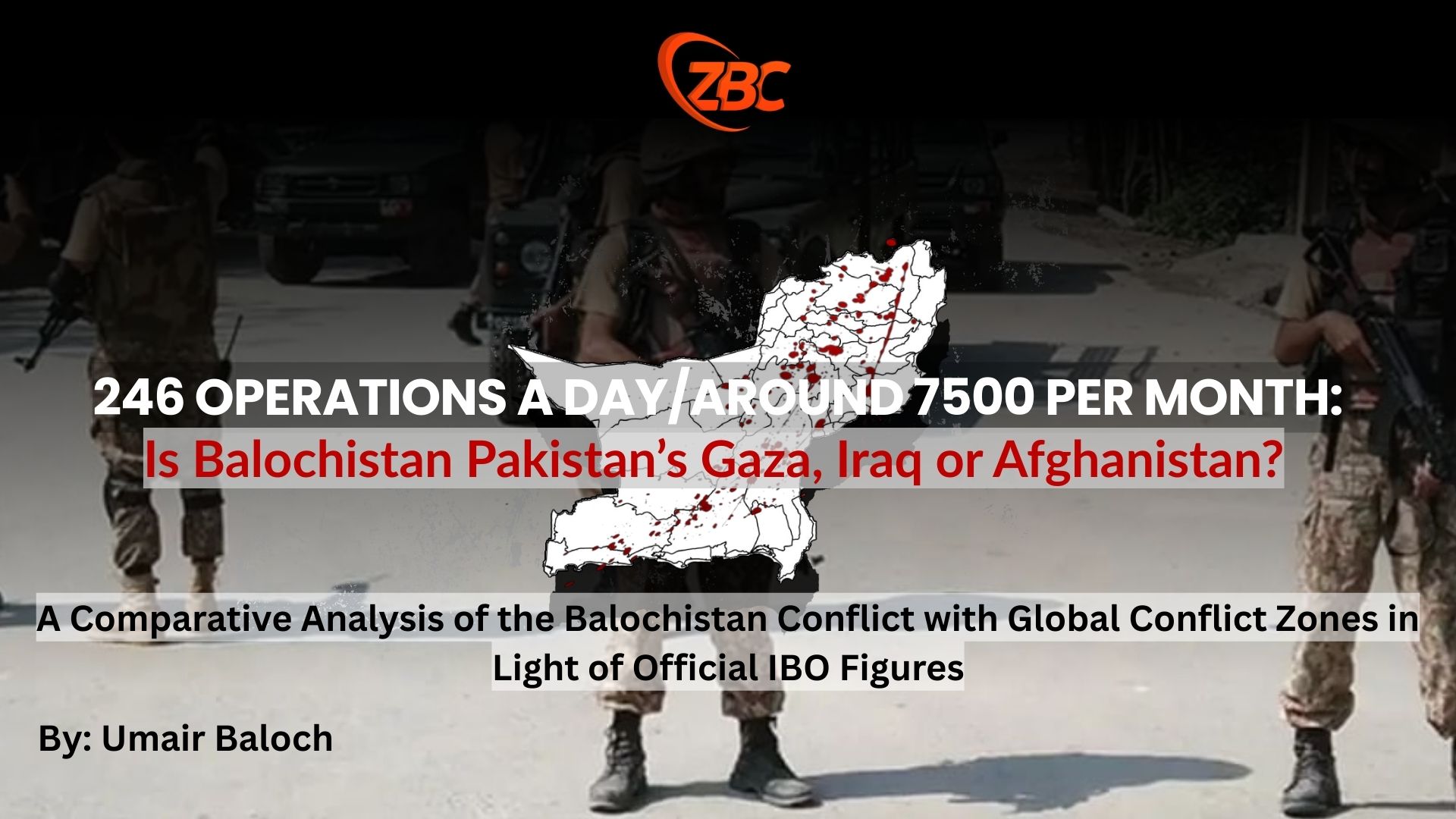
If accurate, the figure of 90,000 intelligence-based operations in a single year represents the highest annual total ever publicly claimed for Balochistan, surpassing even the peak years of unrest under former military ruler Pervez Musharraf. Broken down, the figure translates to approximately 246 operations per day, a level of security activity that demands international comparison.
How conflict zones compare globally
In conflict research and military doctrine, intelligence-based operations are treated as a proxy indicator of conflict intensity. While no universal benchmarks exist, comparative studies of counterinsurgency campaigns worldwide provide useful reference points.
In low-intensity conflict environments, such as Northern Ireland in the post–Good Friday Agreement period, intelligence operations were limited, averaging five to fifteen per month, primarily focused on surveillance and targeted arrests.
By contrast, medium-intensity conflict zones, such as Afghanistan between 2016 and 2019, experienced 300 to 900 intelligence-based operations per month nationwide, including frequent night raids conducted by Afghan and NATO forces.
At the high-intensity end, Iraq during the 2006–2008 insurgency peak saw twenty to forty intelligence-led operations per day in Baghdad alone, with nationwide monthly figures exceeding one thousand operations. This period is widely regarded as a near–civil war.
Similarly, during periods of escalation in the West Bank, Israeli security forces conduct 300 to 600 intelligence-based operations per month, a level associated with persistent, open confrontation.
Where Balochistan fits
Placed within this global context, the claimed 90,000 IBOs in Balochistan, equivalent to roughly 7,500 per month or 246 per day, align not with low- or medium-intensity conflicts, but with some of the most heavily militarized conflict zones in the world.
Yet this stands in stark contrast to repeated official assertions that Balochistan faces only a “few miscreants” and that the conflict’s intensity is limited.
The contradiction becomes sharper when viewed alongside remarks made in April by Chief of Army Staff General Asim Munir, who stated that around 1,500 individuals belonging to groups such as the BLA, BLF, and BRA could not “take Balochistan away from Pakistan,” adding that even their “ten generations” would fail to do so.
If one accepts this estimate and also accepts the official claims, a fundamental question arises: why would approximately 90,000 intelligence-based operations be required to control an estimated force of 1,500 insurgents? By the end of 2025, such figures should logically have resulted in a significant reduction of the Balochistan conflict. However, the ground reality suggests otherwise. With the arrival of the new year, one would reasonably expect a shift toward peace and a substantial decrease in military operations. Instead, from the very beginning of 2026, reports of enforced disappearances and extrajudicial killings appear to be continuing at the same intensity, indicating that the conflict has neither subsided nor moved toward normalization.
The reported scale of intelligence operations suggests the province has been experiencing extraordinary levels of securitization, comparable to active war zones rather than regions of declining unrest.
Other claims and arrests
During the press conference, DIG CTD Aitzaz Goraya highlighted the arrest of Sajid alias “Chavez,” whom he described as a key militant operative. According to the CTD, Sajid studied at the International Islamic University Islamabad, and previously worked as a teacher at Turbat University. He was allegedly arrested while transporting weapons from Panjgur, including modern arms, suicide jackets, and ammunition.
The DIG further claimed that investigations revealed young people were being used to supply money and medicines to militants, and that medical equipment and drugs from government hospitals had reached armed groups. Arrests were also reported from Kharan and other areas.
Officials also accused the Baloch Yakjehti Committee (BYC) of facilitating banned militant outfits, an allegation the BYC has consistently denied.
A question of narratives
Taken together, the government’s own statistics raise a fundamental question: Is Balochistan a low-intensity conflict zone with a limited number of militants, or a province requiring hundreds of intelligence-driven operations every day?
Comparative global data suggests that such an operational tempo is characteristic of high-intensity conflict or war-like environments. Both narratives, minimal militancy and extreme security activity, cannot be true simultaneously.
Until these contradictions are addressed transparently, official claims of declining violence and normalization in Balochistan will remain difficult to reconcile with the government’s own numbers.
Umair Baloch is a researcher, journalist, and editor at ZBC English.