WRITER: ANEESA BALOCH
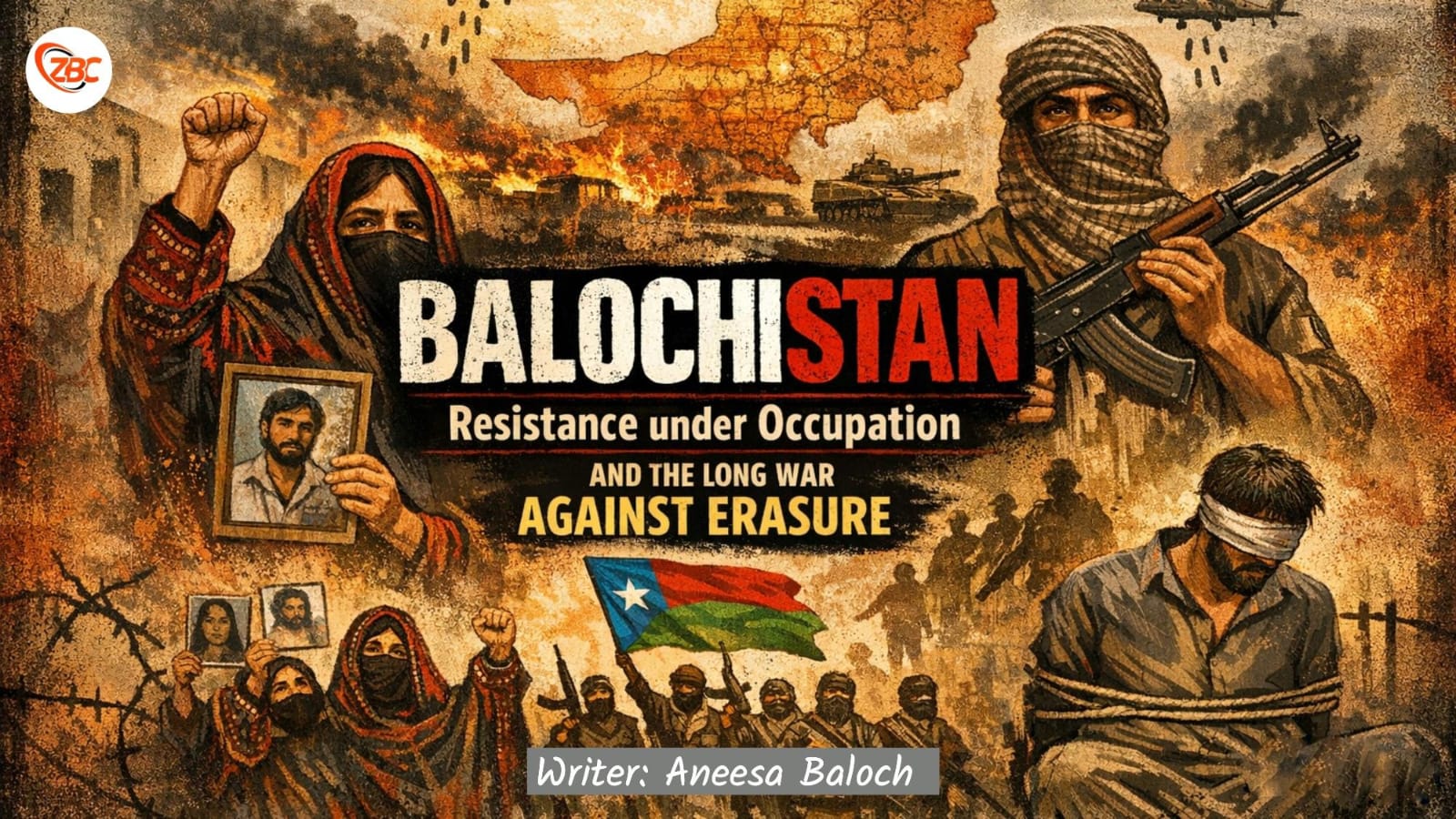
The recent militant attack in Balochistan, attributed to the Baloch Liberation Front (BLF), which reportedly killed civilians, Pakistani soldiers, and members of the group itself, has once again jolted Pakistan into momentary attention. Such incidents are often framed by the state as isolated acts of “terrorism,” stripped of history, politics, and context. Yet, these eruptions of violence are not sudden storms; they are symptoms of a conflict that has been festering for nearly eight decades under military repression, colonial-style domination, and systematic denial of a people’s rights.
To mistake these attacks as signs of an imminent military or political breakthrough for the Baloch would be a grave misreading of reality. The Pakistani state possesses overwhelming coercive power in Balochistan, designed not merely to defeat insurgents but to exhaust an entire society into submission. And yet, despite this imbalance, the Baloch struggle refuses to die.
A Land Annexed, Not Integrated
The roots of the Baloch conflict lie in the forceful annexation of the sovereign Baloch state of Kalat in March 1948. At the time of Partition, Kalat was not a British colony like much of India, but a princely state with treaty-based autonomy. Its ruler, Khan Mir Ahmad Yar Khan, sought independence, not accession to Pakistan. Negotiations were underway when Pakistan chose force over consent, invading Kalat and imposing its writ through military action.
That moment defined the moral foundation of Baloch nationalism. For many Baloch, Pakistan was never a voluntary union, it was an occupation imposed at gunpoint. What followed were repeated uprisings in 1948, 1958, 1963, 1973–77, and again from 2004 to the present day. Each rebellion was crushed with overwhelming military force, leaving behind mass displacement, executions, and deepened alienation.
Militarization and the Architecture of Fear.
Today, Balochistan is one of the most heavily militarized regions in South Asia. Pakistani leaders openly admit that the Balochistan’s vast geography requires extraordinary troop deployments, yet they deny the very deprivation that fuels resistance. The military-intelligence apparatus operates with near-total impunity, enforcing control through checkpoints, raids and surveillance.
Enforced disappearances have become the most feared instrument of state terror. Political activists, Journalists, Lawyers, Teachers, Doctors, Students even women are routinely Disappeared. Thousands are believed to be held in military detention centers without charge or trial. Many are never seen again. Bodies bearing marks of torture frequently surface in desolate areas, serving as warnings to entire communities. This is not counterinsurgency; it is collective punishment.
Cultural Erasure and Colonial Control
Beyond physical repression lies a quieter but equally devastating assault on Baloch identity. The Balochi language is excluded from formal education. Cultural festivals are restricted or disrupted. Nationalist symbols are criminalized. Islamabad promotes a homogenized Islamic-national identity that leaves little room for Baloch history, tribal structures, or secular traditions.
For many Baloch, this amounts to cultural genocide an attempt to erase a nation without formally acknowledging its existence. Colonial rule does not always arrive with foreign flags; sometimes it comes wrapped in the rhetoric of “national unity.”
Resource Wealth, Local Poverty
Balochistan is Pakistan’s largest and most resource-rich province, endowed with Gas, Coal, Gold, Copper, and a strategically vital Coastline. Yet it remains the poorest, most underdeveloped region of the country. The benefits of extraction flow outward to Islamabad, to multinational corporations, and increasingly to China while local communities lack clean water, healthcare, and education.
Mega-projects like Gwadar Port and the China-Pakistan Economic Corridor (CPEC) are marketed as engines of development. For the Baloch, they symbolize dispossession. Land is acquired without consent, jobs go to outsiders, Chinese interests are protected by military force, and demographic engineering marginalizes the indigenous population. Peaceful protests against these projects are met with Bullets, Tear gas, and Mass arrests.
Armed Resistance and Its Limits
Baloch nationalist armed groups emerged not out of romantic militancy but from the systematic closure of political space. Organizations such as the BLF and others target military convoys, state installations, and CPEC-related infrastructure, viewing them as symbols of occupation. Pakistan brands them terrorists; many Baloch see them as resistance fighters.
Yet the harsh truth remains: militancy alone cannot defeat a nuclear-armed state with one of the largest standing armies in the world. The military can absorb attacks, retaliate disproportionately, and tighten its grip. Each violent episode, while exposing the state’s vulnerabilities, also provides justification for further repression. The struggle, therefore, remains trapped between the brutality of the occupier and the limitations of armed resistance.
Silenced Voices, Enduring Symbols
Despite censorship, Baloch resistance has produced figures who embody both armed and non-violent struggle. Nawab Akbar Bugti, a former governor turned rebel, was killed in a military operation in 2006, igniting a new phase of insurgency. Human rights activist Karima Baloch, who took the Baloch cause to international forums, was found dead under mysterious circumstances in Canada in 2020 widely believed to be an extraterritorial assassination.
At the same time, non-violent resistance persists. Elderly activists have walked thousands of kilometers demanding justice for the disappeared. Mothers of missing persons hold daily protests, clutching photographs of sons who vanished into the military’s shadow prisons. These acts challenge the state’s narrative more powerfully than any bullet.
Geopolitics and Global Silence
Pakistan’s strategic value has insulated it from accountability. Western powers overlook abuses due to security interests in Afghanistan and rivalry with China. China itself has become deeply invested through CPEC, tying its economic ambitions to the suppression of Baloch dissent. Gulf states back Pakistan for sectarian and political reasons.
This convergence of interests has left the Baloch isolated forced to internationalize their struggle through diaspora activism, protests in London, Geneva, Berlin, and Washington, and digital campaigns under hashtags like #FreeBalochistan and #SaveBalochStudents. Their demands are modest by international standards: UN investigations, sanctions on responsible officials, and the right to self-determination.
A Struggle That Refuses to End
Despite decades of repression, the Baloch struggle remains alive. A new generation more educated, globally connected, and politically conscious refuses to accept silence as destiny. They are not asking for privilege or charity. They are demanding freedom from occupation, justice for the disappeared, control over their land, and dignity as a people. This is not a war born of hatred toward ordinary Pakistanis. It is a resistance rooted in love for land, culture, and future. History will judge not only those who oppressed, but also those who chose silence in the face of barbarism.
The Baloch are fighting with stones, words, memory, and hope. Let the record show: they resisted, they endured, and they refused to vanish.