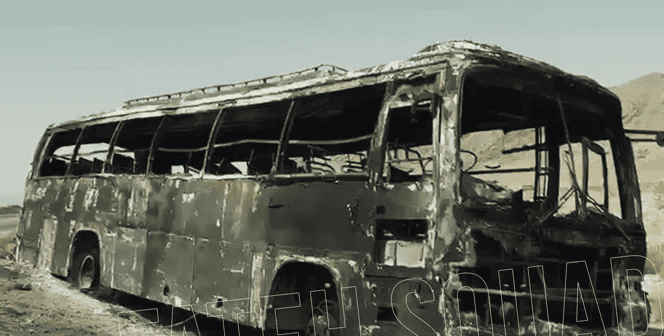
QUETTA, BALOCHISTAN: Baloch Liberation Army (BLA) spokesperson Jeeyand Baloch has claimed responsibility, in a statement issued to media, for the July 16 attack in Mustung, in which the group claims 62 Pakistani military personnel, including three officers, were killed.
According to the spokesperson, the BLA’s Fateh Squad, along with other units, carried out coordinated, organised, and highly intense attacks at three different locations in the Khadkocha area of Mustung on Thursday, July 16, targeting a large convoy of what the statement referred to as the “occupying Pakistani army”, its security escort, and military reinforcements that arrived at the scene afterward. As a result of these actions, the statement claims, 62 personnel, including three officers, were killed on the spot, with a large number seriously injured. The statement said this intense engagement, which continued for two days despite the enemy deploying heavy air power, ended with all units achieving their objectives and returning safely to their bases.
The spokesperson said that at approximately 12 noon on Thursday, a convoy of the “occupying Pakistani army” advancing from Quetta toward Panjgur was ambushed by BLA fighters based on prior intelligence obtained under the codename “Zirab.” The statement claims the convoy consisted of 18 buses and dozens of security vehicles, carrying more than 550 armed personnel from various military wings, including the 91 Wing, 164 Wing, 59 Wing, Panjgur Rifles, Mekran Scouts, and Dasht Scouts.
According to the statement, the BLA’s vanguard “Fateh Squad” launched a sudden attack with automatic and heavy weapons on the front portion of the convoy and its main security vehicles at a location called “Guru” in Khadkocha. The statement claims four buses of the “occupying army” were directly hit in this attack, with one bus completely engulfed in flames and burned to ashes, killing all personnel aboard on the spot. During the same attack, the statement claims, the fighters also targeted and completely destroyed a special vehicle carrying military officers, killing three senior officers on the spot.
The statement said that other units of the fighters, with great skill, surrounded the remaining vehicles assigned to convoy security, completely paralyzing their advance and breaking the enemy’s defensive formation. It claims that immediately after the attack, when the “occupying army” attempted to send additional reinforcements from nearby camps, fighters already positioned in the area ambushed and repeatedly struck these reinforcements at two further locations. The statement claims these successive attacks gave enemy forces no opportunity to regroup, and the entire area echoed with the sound of explosions for several hours.
Jeeyand Baloch further stated that after suffering severe disarray and heavy casualties on the ground, the “occupying Pakistani army” deployed gunship helicopters, fighter jets, drones, and heavy air power in an unsuccessful attempt to encircle the entire area, prolonging the engagement continuously for two days and nights. The statement claims the enemy made indiscriminate use of advanced aerial and ground technology and heavy bombardment, affecting public places, mosques, and religious seminaries, but that the fighters, employing superior strategy, guerrilla warfare expertise, and geographical advantage, foiled all of the enemy’s counterattacks and inflicted further losses in personnel and equipment. Despite this lethal engagement, two days of intense clashes, and severe aerial bombardment, the statement claims all fighters of the Fateh Squad and other units remained completely safe and, after successfully achieving their operational objectives, safely relocated to their designated combat zones.
The spokesperson added that the scale of this two-day engagement, the destruction of a convoy of more than 550 personnel, and the fact that not a single fighter was injured despite the enemy’s full air power, is in the BLA’s own characterization clear evidence of the organization’s highest level of military training, unmatched discipline, and what it described as unassailable intelligence networks on the ground.
The statement said this outcome sends a clear message to Pakistan’s security institutions that their advanced technology, aerial bombardment, and numerical superiority have proven completely ineffective against the geographical knowledge and national resolve of Baloch fighters. The Baloch Liberation Army reiterated its stated commitment to continuing attacks of this nature against the “occupying army” with greater intensity until what it called the ultimate goal of “national liberation” is achieved.