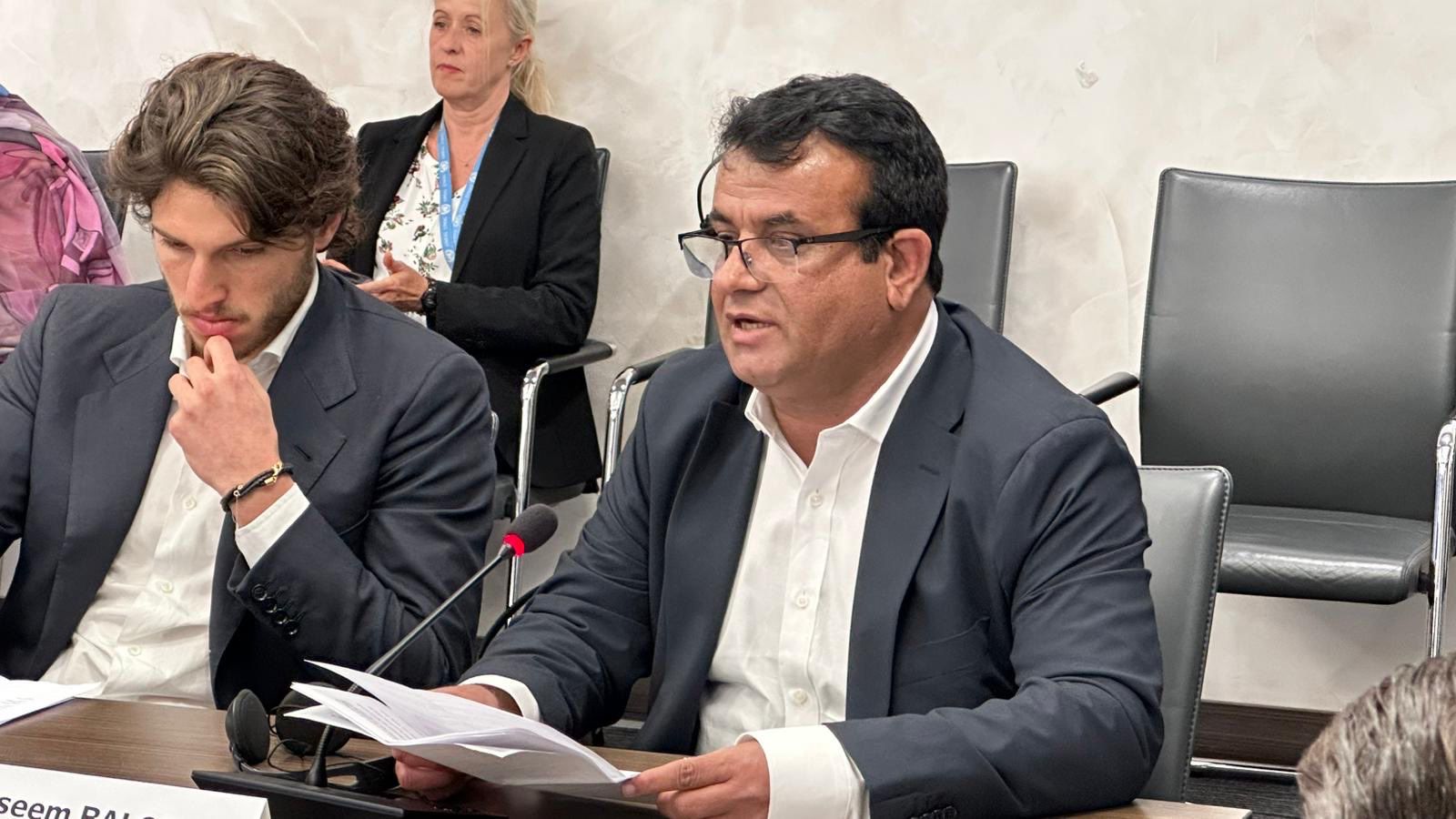
GENEVA: Chairman of the Baloch National Movement (BNM), Dr. Naseem Baloch, addressed the 61st session of the United Nations Human Rights Council (UNHRC), presenting a detailed account of the human rights situation in Pakistan, with particular focus on Human Rights Violations Balochistan.
In his address, Dr. Baloch thanked the organizers and recognized the platform provided to discuss human rights issues in Pakistan and the implications of its preferential trade status under the Generalised Scheme of Preference, commonly known as GSP Plus. He emphasized that the European Union granted Pakistan this special trade status with the expectation of compliance with international conventions on human rights, labour rights and democratic governance, noting that the intention behind this trade privilege is clear.
“Trade privileges should encourage governments to respect the fundamental rights and dignity of their citizens,” Dr. Baloch stated, but observed that the reality on the ground in Balochistan tells a very different story. He highlighted that for decades, the people of Balochistan have faced systematic and widespread human rights violations, including enforced disappearances, extrajudicial and custodial killings, arbitrary detention, torture, and the suppression of political voices.
He said that thousands of Baloch political activists, students, journalists and ordinary civilians have been forcibly disappeared, many held in secret torture centres without access to courts or contact with their families. Some later reappear as mutilated bodies found on roadsides, a practice widely referred to as the kill-and-dump policy. In 2025 alone, 1,355 cases of enforced disappearances and 229 extrajudicial killings were documented.
Dr. Baloch shared alarming figures for 2026 up to March 20, citing 228 enforced disappearances and 81 extrajudicial killings, noting that these disappearances included teenage women. Out of ten women, five were later released after being tortured, and one was publicly presented in the media with fabricated charges. He highlighted that 21 of these killings occurred within the first ten days of March in Panjgur, Balochistan.
He emphasized that for many families, human rights are not abstract concepts but the difference between knowing whether their son is alive or spending years searching for a dead body. Mothers, sisters, and children continue to protest peacefully, holding photographs of their missing loved ones, marching hundreds of kilometres to Islamabad demanding justice. Yet, according to Dr. Baloch, their voices remain largely unheard.
Dr. Baloch underlined that these actions constitute clear violations of international human rights law, including the International Covenant on Civil and Political Rights and the Convention Against Torture, both ratified by Pakistan. He also raised concerns over the shrinking space for political dissent and civil liberties, citing the arrest and treatment of former Prime Minister Imran Khan as an indicator of broader democratic deficiencies.
He stressed that unlawful arrests, politically motivated prosecutions, and denial of due process must be condemned wherever they occur, emphasizing that violations in Balochistan are state-led and systemic. He warned that even when Imran Khan was in power, the suffering of the people of Balochistan did not end, and that many members of his political party now face repression similar to that endured by Baloch activists, students, and political workers for decades.
Dr. Baloch highlighted that ignoring injustice against marginalized or politically inconvenient victims allows violations to spread across Pakistan, noting that despite this alarming human rights situation, Pakistan continues to benefit from the EU’s GSP policy. He questioned what message this sends if human rights conditions attached to trade agreements are not enforced, urging that GSP conditionality must be a genuine mechanism to encourage reform and accountability.
He respectfully called on policymakers within the European Union and members of the European Parliament to conduct a serious and transparent review of Pakistan’s compliance with its human rights commitments under GSP, insisting that independent human rights organizations, civil society groups, and the families of victims, particularly from occupied Balochistan, must be included in this process.
Dr. Baloch also addressed a Member of the European Parliament who spoke through the radio, expressing gratitude for highlighting the plight of the Baloch people and urging her to continue advocating for human rights and democratic values globally. He emphasized that the people of Balochistan look to European institutions and human rights activists to be the voice of the voiceless.
He concluded by clarifying that the people of Balochistan are not asking for privileges but are demanding freedom, justice, and self-determination in accordance with the UN Charter and that trade agreements should never silence the voices of victims. Dr. Baloch reaffirmed that if human rights conditionality under GSP is to have any meaning, it must result in justice and protection for the people of Balochistan.