WRITER: ANEESA BALOCH
Balochistan, a land blessed with some of the richest mineral reserves in the world, stands today as a stark paradox: immense natural wealth coexisting with deep poverty and systemic neglect. Beneath its rugged terrain lie vast deposits of gold, copper, coal, and other valuable resources, from Saindak to Reko Diq. Yet, for the people of this region, these riches have brought little prosperity. Instead, they have become the centre of a growing narrative of exploitation involving Pakistan and China, raising serious questions about ownership, transparency and justice.
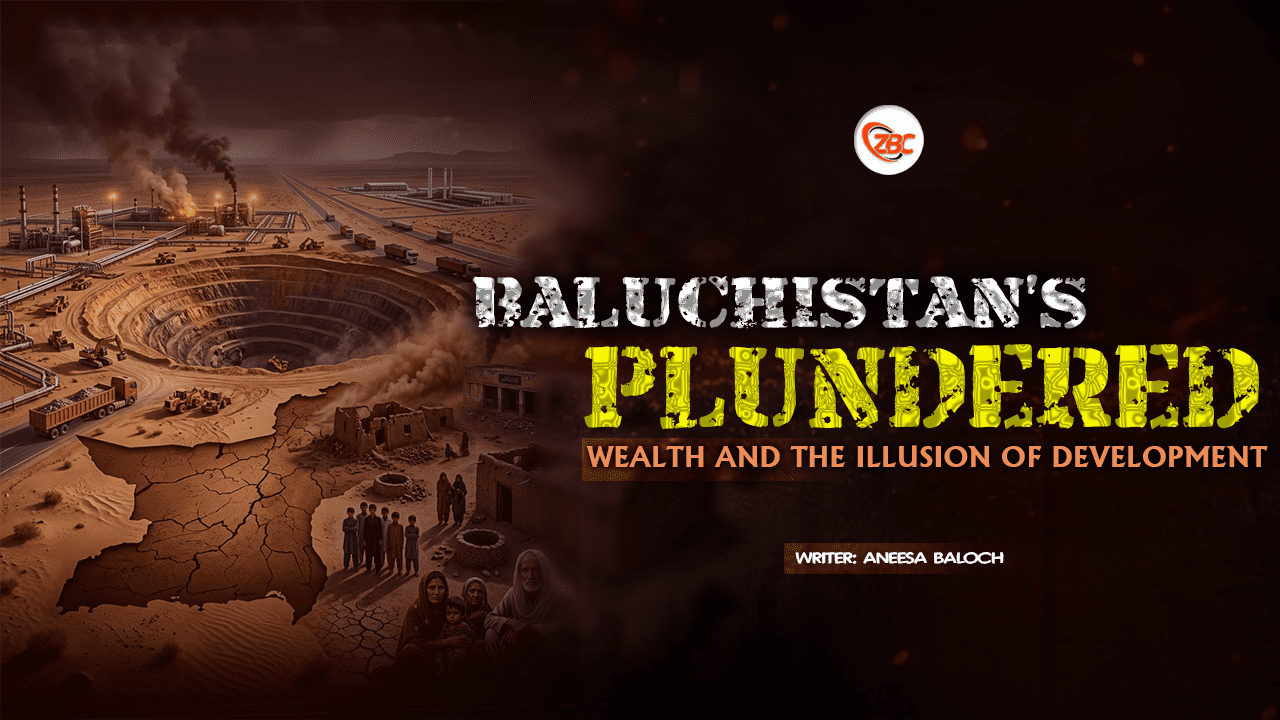
At the heart of the controversy lies the Saindak copper-gold project, often cited as a symbol of how Baluchistan’s resources are being managed. Over the years, concerns have mounted that large-scale extraction is taking place with minimal public oversight and negligible benefit to the local population. The absence of refining and processing facilities within Balochistan means that raw materials are transported elsewhere, preventing the region from building its own industrial base. What remains behind is not development, but deprivation.
Equally troubling is the exclusion of Baloch people from meaningful participation in these projects. Despite operating on their land, many locals allege they are denied fair employment opportunities, with skilled positions often going to outsiders while Baloch workers are relegated to low-paying, insecure roles. This pattern has fuelled perceptions of institutional discrimination, reinforcing the belief that economic structures are deliberately designed to marginalise the indigenous population rather than uplift it.
The opacity surrounding extraction operations only deepens these concerns. With little reliable data available, it is nearly impossible to determine the true scale of wealth being generated from Baluchistan’s mines. This lack of transparency has led to widespread suspicion that profits are being diverted away from public welfare. Critics frequently point to the visible wealth of Pakistan’s power elite, particularly within military and political circles, as indicative of where the benefits may ultimately be flowing.
Beyond economics, the issue takes on a more troubling dimension when viewed through the lens of strategic priorities. It is often argued that the revenues derived from Baluchistan’s resources are not being reinvested in local development but are instead supporting broader military ambitions. From the expansion of defence capabilities to the strengthening of strategic assets, these allocations raise uncomfortable questions about whether the province is being used as a resource base to fund objectives that do little to improve the lives of its own people.
China’s role, particularly through projects linked to the China-Pakistan Economic Corridor (CPEC), has further complicated the situation. While CPEC is officially framed as a transformative development initiative, critics contend that it has enabled a model of extraction that prioritises external interests over local welfare. The growing presence of Chinese companies in Baluchistan’s mining sector is often seen not as a partnership of equals but as part of a broader arrangement that lacks accountability and transparency.
For many observers, the unfolding situation in Balochistan bears an unsettling resemblance to historical patterns of colonial exploitation. The comparison may seem strong, but the parallels are difficult to ignore: resource-rich regions controlled by external powers, local populations excluded from economic benefits, and wealth flowing outward while poverty remains entrenched. From the Congo under Belgian rule to colonial India and French Algeria, history offers numerous examples of how such dynamics unfold and how they are eventually judged.
Today, Balochistan appears to be following a similar trajectory, where the promise of development masks a deeper reality of dispossession. Villages near major project sites reportedly lack basic infrastructure, even as roads are built to facilitate industrial operations. Educated youth struggle to find opportunities, while Balochistan’s vast wealth continues to leave its borders. The disconnect between resource extraction and human development could not be more evident.
The implications extend beyond Balochistan itself. If the concerns being raised are even partially valid, they point to a broader challenge of governance, accountability and ethical development. The question is not merely about who controls the resources but about who benefits from them and at what cost.
As the world becomes increasingly sensitive to issues of economic justice and sustainable development, the situation in Balochistan demands closer scrutiny. The voices emerging from the region are not just calling attention to exploitation; they are demanding recognition, fairness, and a rightful share in the wealth of their own land. Ignoring these concerns risks perpetuating a cycle of inequality that history has repeatedly shown to be unsustainable.
Balochistan’s story is still being written. Whether it becomes a case study in equitable development or a modern example of resource exploitation will depend on the choices made today by those in power, by international stakeholders and by a global community that can no longer afford to look away.