LONDON: The Baloch National Movement (BNM) organized a seminar in London to mark the fifth anniversary of the martyrdom of Shaheed Banuk Karima Baloch, highlighting her political legacy, resistance, and the unity of oppressed nations. The event was attended by political leaders, intellectuals, human rights activists, and representatives of various oppressed nations, including Sindhi, Pashtun, Kashmiri, and Gilgit-Baltistan communities, symbolizing inter-national solidarity against oppression.
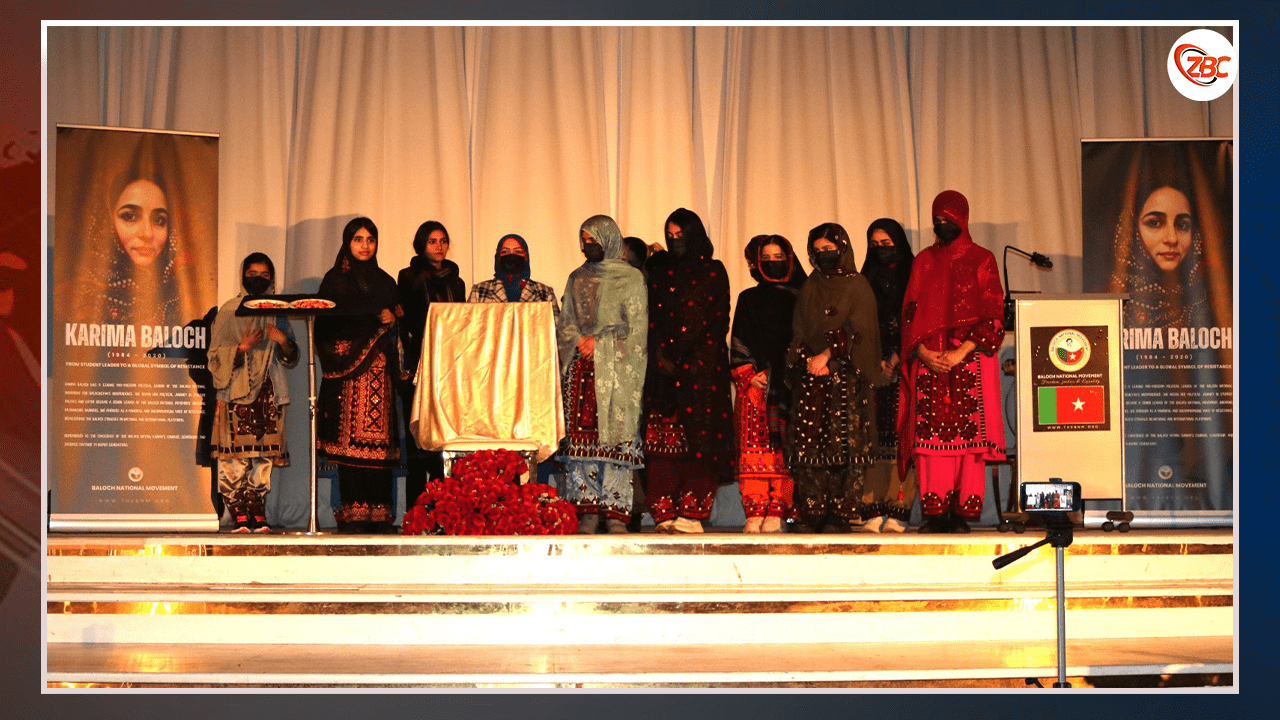
The seminar began with welcoming remarks by BNM members Mahganj Baloch and Durreen Baloch. Participants observed a one-minute silence in memory of Banuk Karima Baloch, followed by a tribute from Baloch women who laid flowers and lit candles beside her portrait created by artist Sanji Baloch.
A short documentary titled “Banuk Karima: Life, Struggle, and Legacy” was screened, showcasing her political journey, fearless leadership, and enduring influence as a global symbol of resistance. The event also featured the launch of the book “Karima Baloch: From Student Leader to a Global Symbol of Resistance,” published by Zrumbesh Publications. A song dedicated to Banuk Karima, produced by the Media Cell of BSO-Azad, concluded the cultural segment of the program.
Addressing the seminar, BNM Chairman Dr. Naseem Baloch described Banuk Karima Baloch as a leader of exceptional political insight who identified the root cause of oppression faced by Baloch, Sindhi, Pashtun, and Kashmiri nations as a Punjabi-dominated military colonial state. He stated that her exile was imposed rather than chosen and emphasized that her life and martyrdom exposed the colonial character of the Pakistani state. Dr. Naseem Baloch criticized the selective application of human rights by Western governments and stressed that peace in the region is impossible without dismantling colonial structures and ensuring freedom for oppressed nations.
Political analyst and author Dr. Naseer Dashti said Banuk Karima Baloch transformed the foundations of the Baloch national struggle and inspired a new generation, particularly Baloch women, to actively participate in politics and resistance. He urged the current leadership to adopt principled and bold political decisions in line with global realities.
University of London scholar and SOAS South Asia Centre member Burzine Waghmar held Pakistan’s deep state responsible for the killing of Karima Baloch, criticizing international silence and the lack of a transparent investigation by Canadian authorities. He warned that impunity and political interests continue to shield human rights violations in Balochistan.
Fahmeeda Khushik, Deputy Organizer of the World Sindhi Congress (UK & Europe), said Karima Baloch played a vital role in mobilizing Baloch youth and raising international awareness about enforced disappearances and extrajudicial killings. She described Karima’s martyrdom as a shared loss for both Baloch and Sindhi nations.
Human rights activist Noor-e-Maryam Kanwar highlighted the use of collective punishment to suppress Baloch resistance, citing recent cases where families of activists are targeted. She described the Baloch Women’s Red March as a continuation of Karima Baloch’s struggle and leadership.
Pashtun Tahafuz Movement (PTM) representative Barkhna Syed expressed solidarity with the Baloch struggle, stating that enforced disappearances and repression are common across Pashtun regions as well. She described Karima Baloch as a symbol of courage who challenged patriarchy and state oppression.
Banuk Karima Baloch’s cousin, Mehlab Kambar, spoke about her relentless struggle for justice, national identity, and collective resistance. She emphasized that Karima consistently raised her voice against enforced disappearances and encouraged collective participation in the national movement, leaving behind a legacy of courage and commitment.
The seminar concluded with renewed calls for unity among oppressed nations and a reaffirmation of commitment to continue the struggle for justice, dignity, and freedom.