How Pakistan’s effort to rebuild ties with Washington may now be forcing it into its most difficult strategic contradiction yet
For decades, Pakistan has been both an official ally and an unofficial strategic partner of the United States in nearly every major geopolitical adventure in South and West Asia. From the anti-Soviet jihad in Afghanistan during the Cold War to the post-9/11 “war on terror,” Islamabad has repeatedly positioned itself as Washington’s indispensable regional partner. Yet this partnership was never straightforward. It was transactional, layered with distrust, and frequently exploited by both sides for competing interests.
Pakistan leveraged its relationship with the United States to secure military aid, diplomatic protection, and strategic advantage not only against regional rivals but also in managing internal conflicts such as those in Balochistan. Washington used Pakistan as a frontline state whenever it needed access to Afghanistan, intelligence networks, logistics routes, or regional mediation. Neither side fully trusted the other, but both kept returning to the arrangement.
Today, that old framework appears to be under stress again—perhaps more than at any time in recent years.
From Cold War ally to regional broker
Pakistan’s alliance with the United States began with anti‑communist security pacts in the 1950s and deepened dramatically during the Soviet invasion of Afghanistan in 1979. Islamabad became the operational hub of the U.S.–Saudi‑backed Afghan jihad, a partnership that reshaped the region. After 9/11, Pakistan again positioned itself as indispensable to American strategy in Afghanistan, securing billions in military aid and diplomatic protection.
But these alliances came with profound internal consequences.
The Afghan jihad militarized Pakistan’s borderlands, empowered the intelligence services, and embedded jihadist networks into the state’s security architecture. The post‑9/11 era intensified sectarian violence, militant blowback, and a permanent expansion of the security state.
Crucially, Pakistan also used these global alliances to justify intensified internal repression. In Balochistan, critics long argued that Islamabad leveraged its strategic importance to the West to shield itself from scrutiny over political crackdowns and military operations.
This pattern has deeper roots. During the Cold War, Pakistan weaponized Islam as part of its anti‑communist narrative. Many Baloch leaders, particularly in the 1970s, were branded “infidels” or “atheists” for their left‑leaning politics and demands for autonomy. Under General Zia‑ul‑Haq, this ideological framing hardened: liberal, secular, and nationalist voices were systematically suppressed, while religious groups aligned with the state were empowered. The result was a political environment where dissent could be delegitimized not only as “anti‑state” but as “anti‑Islam.”
These dynamics created a long‑lasting structure of impunity: global alliances provided external cover, while religious narratives and militarized policies provided internal justification. Balochistan became one of the clearest examples of how Pakistan’s foreign partnerships and domestic repression reinforced each other.
The recent reset with Washington
Over the past year, Islamabad has clearly attempted to restore closer ties with the United States after a period of diplomatic distance. Analysts have described Pakistan’s recent role in U.S.-Iran diplomacy as one of its strongest diplomatic recoveries in years. Reuters recently noted Pakistan’s transformation “from international outcast to mediator” amid the Iran crisis.
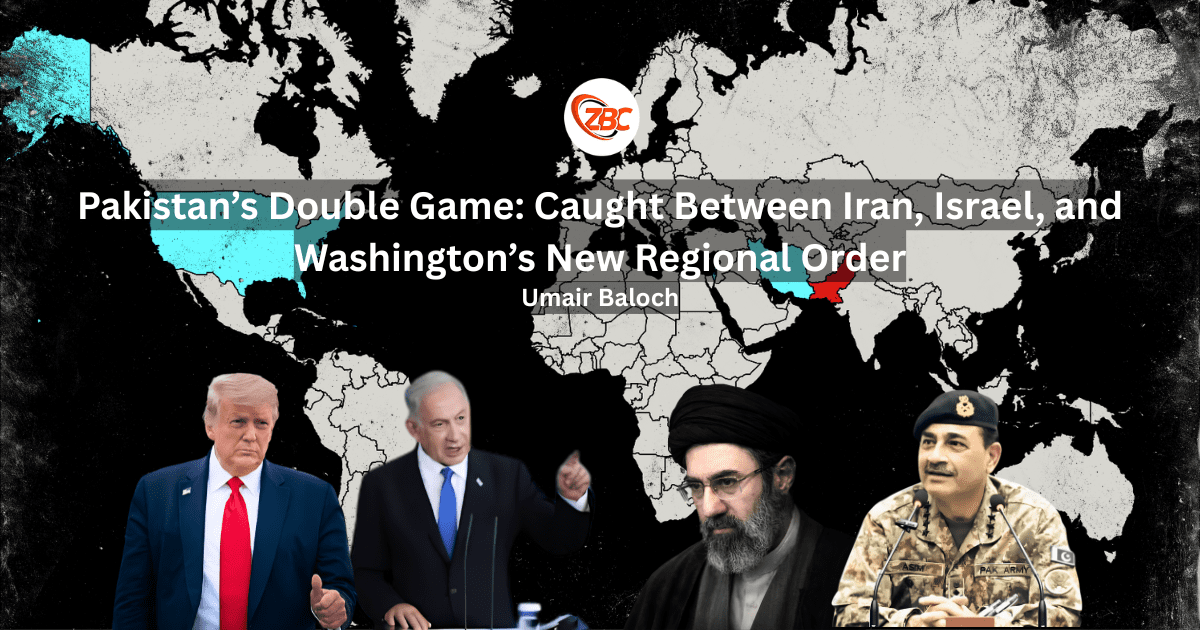
Pakistan’s military leadership—particularly Chief of Army Staff Asim Munir—has been central to that effort. Multiple reports describe him as maintaining direct channels with Donald Trump and playing a visible diplomatic role in contacts around Iran.
This outreach seemed, at first, like a strategic success. Pakistan regained relevance in Washington’s regional calculations. It was again being treated as a useful intermediary between the U.S., Gulf states, and Iran.
But relevance in great-power politics often comes with a cost.
The Israel question: Pakistan’s most difficult diplomatic test
That cost may now be emerging around the question of Israel.
According to Reuters and other international reporting this week, Trump has publicly urged several Muslim-majority states—including Pakistan—to join or engage with the framework of the Abraham Accords, the normalization agreements with Israel. Pakistan has rejected the idea publicly, but the pressure itself is politically significant.
For Pakistan, recognition of Israel is not just another foreign policy adjustment. It is tied to domestic religious politics, the Palestinian question, regional diplomacy, and Pakistan’s own national narrative.
This places Islamabad in an extremely difficult position:
- If it resists American pressure, it risks damaging its renewed relationship with Washington.
- If it moves toward normalization, it risks domestic backlash, political instability, and accusations of strategic surrender.
- If it attempts to continue its traditional ambiguity, it may find that the room for ambiguity is shrinking.
Pakistan has historically mastered balancing contradictory positions. But the Israel question—especially in the middle of war involving Iran, the United States, and Israel—may be much harder to manage through ambiguity alone.
The contradiction inside Pakistan’s military narrative
This challenge becomes sharper because of the rhetoric coming from Pakistan’s own military leadership.
General Asim Munir has repeatedly used religious language in public military messaging, referring to Pakistan’s soldiers as “soldiers of Allah.” This framing resonates strongly with domestic audiences and reinforces the army’s self-image as ideological guardian of the state.
But it also creates a contradiction.
If Pakistan’s state narrative increasingly emphasizes Islamic symbolism, solidarity with Palestine, and moral positioning in the Muslim world, how can the same establishment navigate pressure from Washington to normalize with Israel during a regional war?
That contradiction is not merely rhetorical; it is strategic.
For decades, Pakistan has balanced Islam, nationalism, and security pragmatism. But under current conditions, these three may no longer move together.
The old double game may be reaching its limits
Pakistan has long been accused of playing a “double game” in regional politics: partnering with Washington while maintaining strategic autonomy, cooperating publicly while maneuvering privately, speaking one language abroad and another at home. This balancing act helped the state survive many crises. But the current regional landscape is different.
The U.S.-Iran-Israel conflict has redrawn diplomatic lines across the Middle East. Trump’s effort to expand the Abraham Accords as part of broader regional diplomacy has added new pressure.
Pakistan now finds itself squeezed between:
- Its strategic relationship with Washington,
- Its fragile ties with Tehran,
- Its dependence on Gulf partners,
- Its internal ideological politics,
- And overwhelming public support for Palestine at home.
Its traditional strategy of keeping one foot in every camp is becoming harder to sustain.
A dangerous diplomatic moment
Pakistan sought to restore ties with the United States to regain influence and avoid isolation. In the short term, that strategy succeeded. Islamabad is again central to regional conversations.
But being central also means being exposed.
Pakistan may have regained Washington’s attention—yet attention from Washington often arrives with demands. And this time the demand touches one of the most politically sensitive questions in the Muslim world.
The irony is difficult to ignore: in trying to return as a regional diplomatic player, Pakistan may have stepped into a strategic trap where every available choice carries a political price.
The “great diplomacy” that brought Islamabad back into the room may now be forcing it to answer questions it has spent decades avoiding.
And this time, the old double game may no longer be enough.
The author is an editor at Zrumbesh English. The views expressed are personal and do not necessarily reflect the organization’s position.