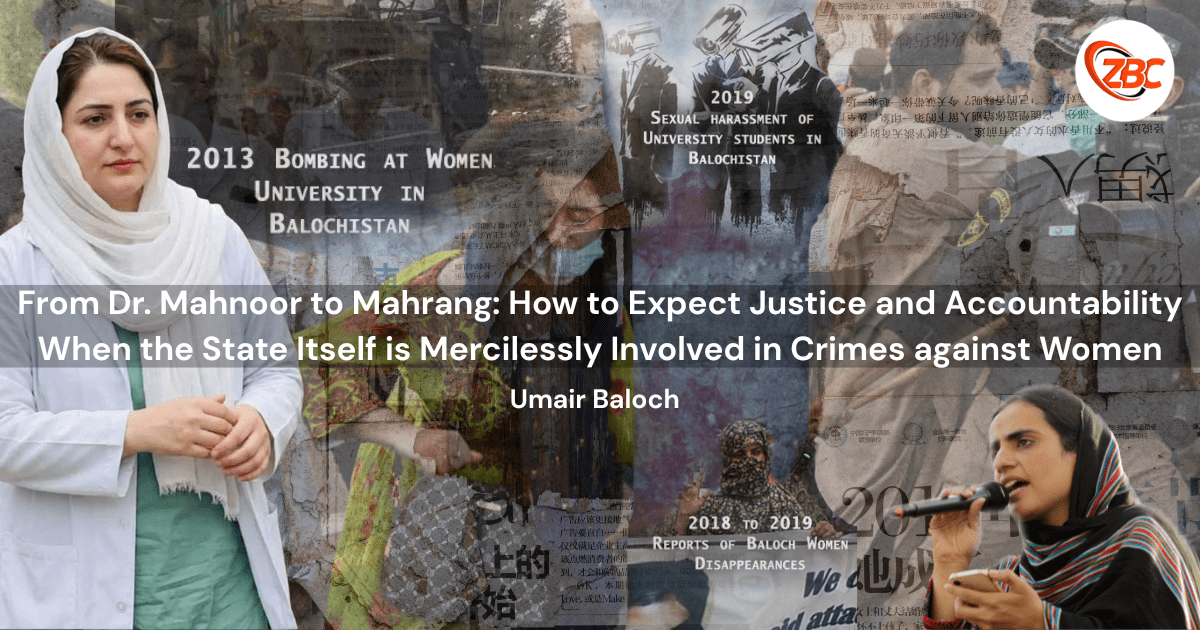
In Balochistan, violence against women is not a series of isolated “incidents”; it is a method. It is policy turned into pain, bureaucracy turned into blood. Every new case feels like a fresh wound, yet it always cuts along the same old scars. From young doctors like Dr. Mahnoor Nasir to seasoned activists like Dr. Mahrang Baloch, women in Balochistan are not just collateral damage in a conflict; they are deliberate targets in a systematic campaign of repression.
Today, an elevator operator in a Quetta hospital throws acid on the face of a lady doctor, flees in panic, drops his identity card, and is traced and killed by police within an hour. No trial. No interrogation. No public report. The investigation ends before it begins, because the point was never justice. The point was to erase questions.
This is how Balochistan’s history is written: not with verdicts, but with silences.
A pattern of terror, not a chain of accidents
From the 2013 bombing of a university bus in Quetta to the virus‑throwing incidents in Mastung in 2019, and from the sexual harassment of female students in Balochistan University hostels to the most recent acid attack in a Quetta hospital, the violence follows a chillingly familiar script. Each episode is treated as a one‑off tragedy, quickly buried under statements of “condemnation” and the formation of yet another “committee.”
There is rarely a transparent investigation, rarely a conviction that restores trust. Women who dare to study, work, or organize find that the price of visibility is vulnerability; the moment they step into public life, the violence sharpens. Their bodies become battlegrounds, their reputations become targets, and every attack is absorbed into a larger pattern that the state refuses to acknowledge.
Women who dared to step into public life, as students, doctors, organizers, journalists, found that the price of visibility was vulnerability. Once women began to mobilize politically, the violence sharpened. Their bodies became battlegrounds, their reputations became targets. The more they stepped forward, the more the state pushed them back, with bombs, with threats, with humiliation.
Enforced disappearances as a gendered weapon
For years, enforced disappearances in Balochistan overwhelmingly targeted men, fathers, brothers, and sons dragged away in the night, leaving women to carry the weight of grief and survival.
Now, the state’s gaze has shifted. Women themselves are being abducted, disappeared, and tortured. Rights organizations document a rising number of Baloch women taken by security forces, students, health workers, housewives, activists, snatched in raids and late-night operations, some subjected to repeated disappearances, some killed in custody.
This is not random cruelty. It is a deliberate strategy: punish women for speaking, for organizing, for refusing to be silent witnesses to the disappearance of their loved ones. The message is clear: if you stand between the state and its crimes, the state will come for you too.
Digital humiliation: when the state enters the body through the screen
The violence is not only physical. It is intimate, invasive, and technologically updated.
State-linked accounts run media trials of Baloch women whose only “crime” is demanding the return of their missing family members. They dissect their lives, question their morality, smear their names. To break their spirit, these accounts circulate AI-generated semi-nude images of Baloch women activists, fabricated pornography as a tool of political repression.
In a conservative society, such images are not just defamation; they are social assassination. The goal is clear: shame them into silence; isolate them from their communities; and turn their courage into a source of fear.
When a state, or those acting in its shadow, stoop to manufacturing sexualized violence through AI, it is not just violating individuals. It is declaring that no boundary, no dignity, no privacy is off-limits in the effort to crush dissent.
The state’s message to women like her is simple:
You are allowed to suffer quietly, but not to organize your suffering into resistance. In Balochistan, being related to a disappeared person is itself treated like a crime. Mothers sit on roadsides holding photographs of sons taken years ago, demanding only a trace, a grave, a name.
Justice denied by design
The acid attack in the Quetta hospital is a perfect metaphor for the wider system. A woman is attacked in a public institution. The perpetrator is killed almost immediately. The case is closed. No one asks: who hired him? Was this premeditated? Did he have links to any group or network?
Why was lethal force used instead of arrest and interrogation?
By eliminating the suspect, the state eliminates the possibility of uncovering a pattern. Each case is sealed off, treated as an isolated “tragedy,” never allowed to connect to the larger architecture of gendered violence and political repression.
In Balochistan, investigations do not fail; they are prevented
The enforced disappearance of Baloch women, the harassment of female students, the bombing of buses, the acid attacks, the AI-generated sexualized images, these are not separate stories. They are different instruments in the same orchestra of fear. The message to women in Balochistan is brutally consistent: if you study, you may be bombed or harassed; if you work, you may be attacked in your workplace; if you protest, you may be disappeared; and if you speak online, your body may be weaponized against you through fabricated images.
And yet, women continue to stand, march, organize, and speak. They refuse to surrender their right to exist as political beings.
The unbearable question: how to expect justice from those who engineer injustice? “When a state and its operators in Balochistan go to this extent, how to expect justice from them?”
The honest answer is: you cannot. Not in the conventional sense. A system that uses disappearance as policy, humiliation as tactic, and gendered violence as strategy is not designed to deliver justice; it is designed to avoid it.
Watch: Silent Sufferings of Balochistan — The Violence Faced by Baloch Women
The views expressed in this article are those of the author and do not necessarily reflect the editorial position of Zrumbesh English.