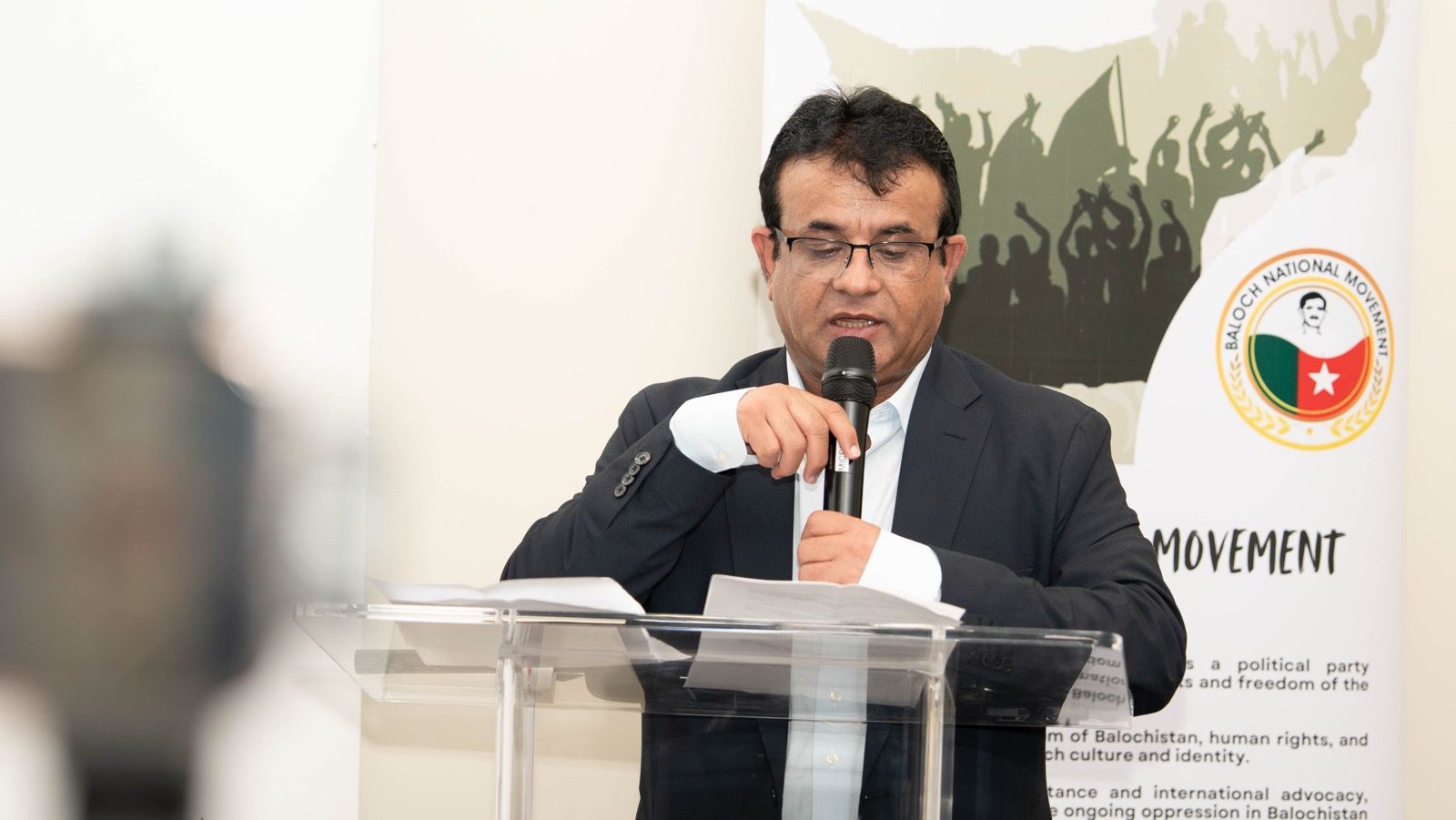
PARIS: On August 14, Baloch National Movement (BNM) Chairman Dr. Naseem Baloch said that the Baloch nation continues to pay the price for the partition of India.
He says that, On August 14, Pakistan celebrates its creation under the banner of independence. In reality, this day marks not genuine independence but the tragedy of the Partition of India. Beneath the rubble of triumphalist narratives and claims of liberation from British colonial rule lie grim realities that continue to haunt the entire region, particularly Balochistan. For the Baloch nation, August 14 is not merely a date on the calendar, it marks the beginning of over seven decades of deep historical injustice.
He stated “We know all too well that in the territories comprising present-day Pakistan, the Muslim League historically had no grassroots presence, nor was there any genuine popular movement for a separate state with the sole exception of a resolution passed by the Sindh Assembly.
The creation of Pakistan was not the inevitable outcome of a natural historical process. Rather, it was born out of British colonial manoeuvres, politically mobilized religious communalism, the disastrous compromises of the Indian National Congress leadership, and the strategic interests of imperial Britain. How could the Muslim League which was willing to accept a united India as late as 1946, independently forge a new country just one year later? The creation of Pakistan was not an isolated triumph of the Muslim League, it was the product of converging agendas between Britain and the Indian National Congress, which ultimately fractured the subcontinent.”
Dr. Naseem Baloch urged the youth to take a broader historical view: “If Baloch youth view the creation of Pakistan solely as a plot by Muhammad Ali Jinnah, the Muslim League, or Britain, their historical analysis remains incomplete. While the Muslim League certainly drove the demand for Partition, what meaningful political resistance did the Congress a party that claimed to champion a united India actually offer to prevent it?
A party that had declared the unity of India as its central ideal for decades failed at the decisive hour to mount even a final political stand. This is why the Indian National Congress shares equal responsibility for the Partition of India. Time proved Congress’s lofty declarations of unity to be mere rhetoric. In truth, for the Congress leadership, preserving a united India was secondary to determining the nature of an independent state: how centralized power would be and with whom that power would have to be shared. By 1947, the Congress leadership preferred a smaller, highly centralised and easily manageable state aligned with their vision over a larger, complex and decentralized India.”
The BNM Chairman further noted that Partition inflicted immense human suffering across the region: Punjab was divided, Bengal was fractured, hundreds of thousands were killed and tens of millions were displaced. Using religion as the foundation for state-building injected a persistent toxicity into South Asian politics.
He emphasized, “The heaviest price for the Partition of India and the creation of Pakistan was paid by the Baloch nation. Following a long tradition of national resistance and backed by formal treaties with Britain, Balochistan declared its independence on August 11, 1947. The stated stance of the Baloch nation was unequivocal: we sought no hostility with either Pakistan or India but wished to maintain our sovereignty while cultivating relations based on equality, peaceful coexistence and formal treaties.
However, that vision was permanently shattered just seven months later when Pakistan forcibly annexed Balochistan on March 27, 1948, stripping away our independence.”
Dr Baloch said that “we must never overlook the intrinsic link between August 14 and March 27. Had Pakistan not been created, the dark date of March 27 would never have occurred in our history. The cost of Partition was borne not only by those who lost their lives in Punjab and Bengal in 1947, but by the Baloch nation, which lost its very national sovereignty.”