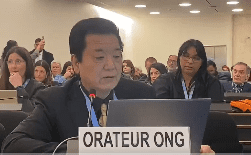
GENEVA: At the 61st session of the United Nations Human Rights Council (UNHRC), Japanese human rights activist Shun Fujiki sharply criticized Pakistan over human rights violations in Balochistan.
Addressing the council, Fujiki asked delegates to “imagine the Baloch mothers who are restless in search of their loved ones,” describing a situation filled with fear and uncertainty. According to his statement, over 1,200 cases of enforced disappearances were reported in Balochistan in 2025 alone, including women and at least 75 students. More than 1,000 individuals remain missing, with ongoing violence, extrajudicial killings and illegal detentions.
Fujiki also accused Pakistani authorities of allowing uncontrolled exploitation of Balochistan’s natural resources. Despite the Balochistan’s rich deposits of copper and gold, local communities reportedly remain impoverished, while external actors gain disproportionate benefits.
He expressed concern over forced displacements of local populations without their consent, describing such actions as violations of international laws, including the UN Declaration on the Rights of Indigenous Peoples (UNDRIP) and the International Covenant on Civil and Political Rights (ICCPR).
The activist also highlighted the prolonged detention of human rights defender Dr. Mahrang Baloch, who has reportedly been imprisoned for over a year following peaceful protests, citing it as an example of state repression.
Calling the situation a “crisis of dignity and justice,” Fujiki questioned the international community’s silence and warned that allowing an entire nation to suffer quietly would be dangerous.
He urged the UNHRC to take concrete measures, including independent investigations in critical areas such as Reko Diq and called on Pakistan to comply with international agreements concerning enforced disappearances and local rights.
Fujiki also recommended that international funding be conditioned on local community consent, employment guarantees, and poverty reduction. Concluding his address, he warned that “justice delayed is justice denied,” emphasizing that the deteriorating human rights situation in Balochistan demands urgent global intervention.