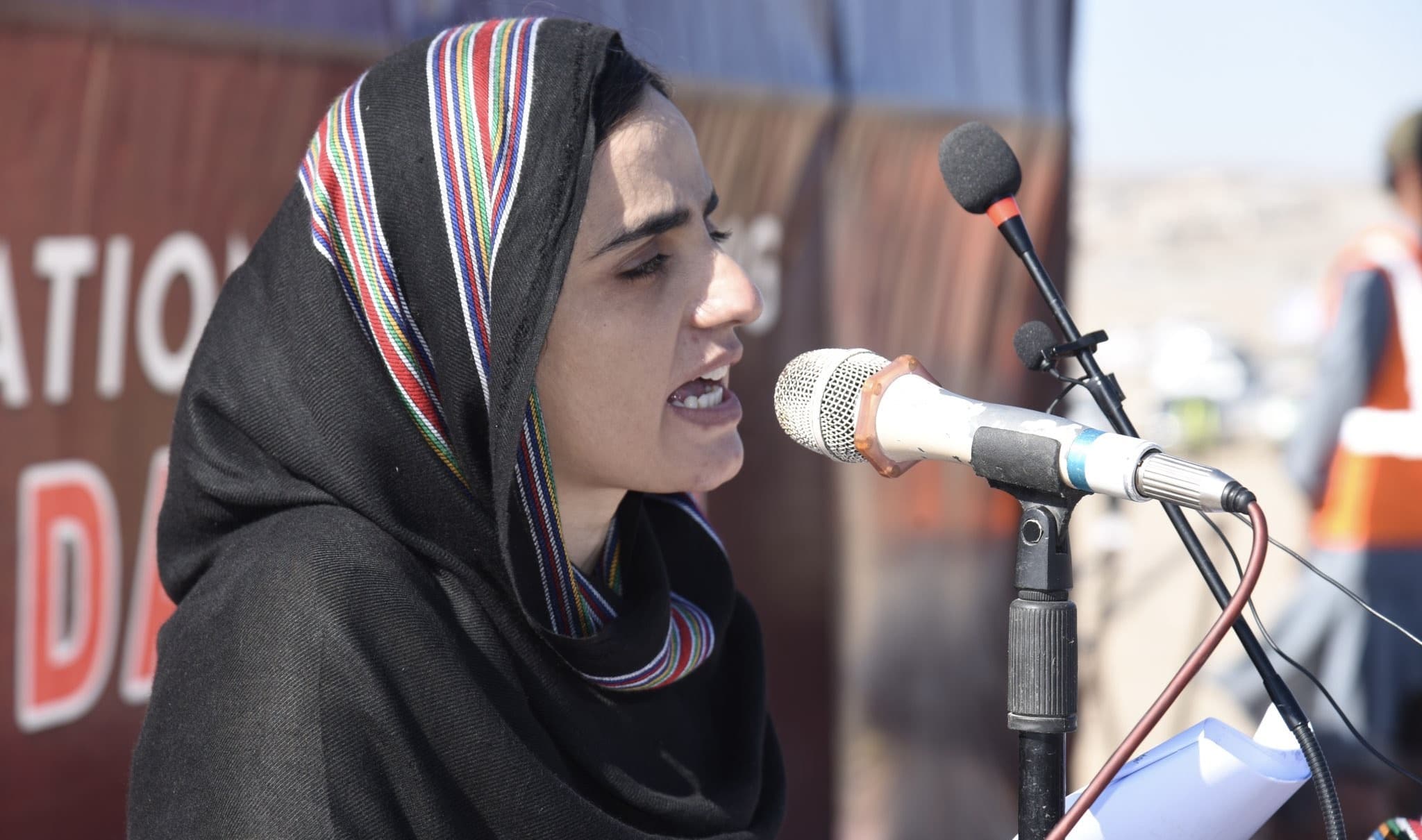
QUETTA, BALOCHISTAN: Dr. Mahrang Baloch, the Leader of Baloch Yakjehti Committee (BYC), currently detained at Haddah Prison in Quetta, issued a formal statement condemning the broad-daylight killing of Professor Ghamkhwar Hayat in Noshki and warned that the violence against Baloch scholars, poets, and educators was not random but ruthlessly calculated.
“The oppressive institutions are most afraid when a peaceful teacher, poet, or intellectual educates the younger generation about national consciousness, mother tongue and historical truth,” she said in her statement. “They fear the teacher more than the soldier.”
Professor Ghamkhwar Hayat, a respected educator, poet, and literary organizer, was shot and killed in Noshki in what witnesses described as a targeted assassination. He was known across Balochistan for founding the Raskoh Literary Council, a cultural institution that served as a gathering space for poetry readings, intellectual debate, and community dialogue.
According to Dr. Mahrang’s statement, the killing did not come without warning. In the months before his death, Professor Hayat had been subjected to sustained harassment. His literary institution was demolished. His name was placed on the government’s Fourth Schedule a security watchlist that imposes strict movement and communication restrictions and he was forcibly transferred to Sibi, far from his community and his work.
Despite these measures, she said that, state-backed armed groups, widely referred to as death squads, ultimately carried out his killing.
“His literary space, the Raskoh Literary Council a center for poetry, dialogue and scholarly conversation was demolished,” Dr. Mahrang said. “He was harassed, listed, and transferred to silence his academic voice. And when none of that worked, they killed him.”
Dr. Mahrang was unambiguous in framing the professor’s murder as part of something far larger than a single act of violence. She described it as one chapter in what she termed “intellectual genocide” a long-running and organized effort to dismantle Baloch literary, cultural and educational foundations.
“This killing is not an isolated tragedy,” she said. “It is another link in a long and deliberate chain.”
She cited the cases of several other prominent Baloch intellectuals who were killed under similar circumstances, including Professor Saba Dashtiyari, Professor Razzaq, Ustad Siraj Zahid Askani, Rafiq Uman, and Abdul Rauf figures whose deaths, she argued, followed a recognizable pattern of surveillance, harassment, marginalization, and ultimately assassination.
In her statement, Dr. Mahrang argued that the targeting of educators and artists served a dual purpose physical elimination and psychological intimidation.
“This strategy is not merely violence,” she said. “It is a psychological and intellectual weapon. Its goal is to break the morale of society and turn educational institutions into places of fear, so that the younger generation grows up afraid of knowledge itself.”
At the heart of Dr. Mahrang’s statement was a broader argument about the nature of intellectual resistance and its resilience in the face of state power.
She contended that the very act of killing teachers and poets exposed a deep fear within those who ordered such killings. A soldier with a gun represents physical force. A teacher with a book, she argued, represents something those in power find far more threatening the transmission of identity, memory, and consciousness from one generation to the next.
“The dominant powers fail to understand,” she said, “that ideologies do not die with blood. The martyred intellectual’s thought and the ink of his pen only grow stronger.”
For Dr. Mahrang, Professor Hayat’s death was therefore not a defeat but a transformation from a living voice into an enduring symbol.
“Professor Ghamkhwar Hayat’s sacrifice has become a sacred symbol for the Baloch nation’s consciousness, language, and cultural survival,” she said. “And it will continue to inspire every coming generation in the defense of resistance, education and national identity.”
Concluding her statement, Dr. Mahrang put forward three specific demands.
First, she called for a transparent, independent, and immediate investigation into Professor Hayat’s killing one free from interference by the institutions she holds responsible.
Second, she urged the international community to pay direct attention to what she described as the full scale of intellectual genocide in Balochistan, arguing that global awareness was essential to holding perpetrators accountable.
Third, she demanded an end to what she characterized as a systematic state policy of suppressing intellectual and literary resistance, so that Baloch scholars and writers could serve their communities without fear for their lives.