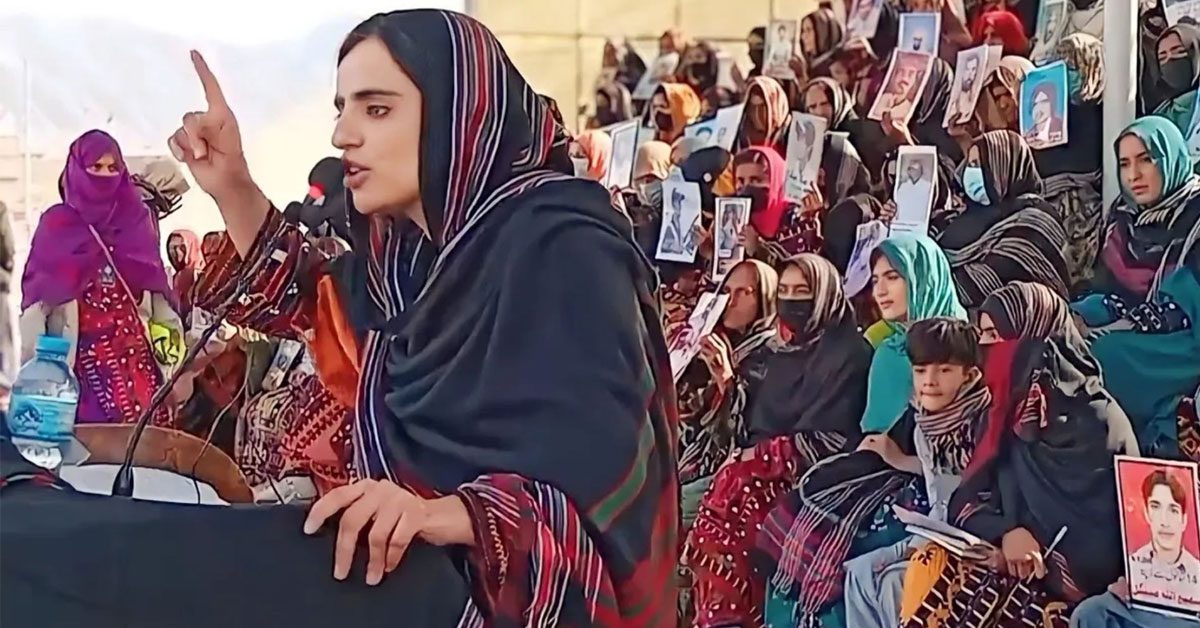
QUETTA, BALOCHISTAN: Dr. Mahrang Baloch, the prominent leader of the Baloch Yakjehti Committee (BYC), has issued a strong statement from detention expressing solidarity with Kashmiri protesters who faced state violence during peaceful demonstrations, while strongly condemning the government’s ban on the Joint Awami Action Committee (JAAC).
In her statement, Dr. Baloch said she strongly condemns the state violence inflicted upon peaceful protesters in Kashmir and stands in complete solidarity with their ongoing struggle for rights, dignity, and justice.
She said the ban imposed on the Joint Awami Action Committee (JAAC) is not merely a prohibition on one organisation, but rather reflects the state’s continued oppressive attitude against freedom of expression, political liberty, and the struggle for fundamental rights of subjugated nations living in Pakistan.
“In democratic societies, dissent is answered through dialogue, justice, and political process not through bans, arrests and violence. It is unfortunate that in Pakistan, popular movements and democratic demands have often been met with force, oppression, and restrictions,” she said.
Writing from inside prison, Dr. Baloch said her heart beats first and foremost with the protesters, the wounded, the grieving families, and the people of Kashmir who took to the streets for their rights and were met with force, violence and repression. “The distance between Balochistan and Kashmir may be thousands of kilometres, but the pain is the same, the wounds are the same, and the desire for justice is the same. I salute the resilience, courage, and struggle of the Kashmiri people,” she said.
Dr. Baloch said that even from behind prison walls, she can hear the voices rising from Balochistan, Khyber Pakhtunkhwa, Sindh, Gilgit-Baltistan, and Kashmir all demanding their basic rights, dignity, identity, and justice. “These prison walls may be high, but not high enough to imprison the grief of nations, the sighs of mothers, and the call for justice,” she said.
Describing what she termed the state’s age-old method of repression, Dr. Baloch said the pattern follows a predictable course first the voices of the people are ignored, then they are discredited; then, restrictions are imposed and finally an attempt is made to silence them through force.
“The state repression faced by the peaceful movement of the Baloch Yakjehti Committee in Balochistan is a continuation of this same policy. Pakistan’s history bears witness to the fact that the political struggles of subjugated nations have repeatedly been suppressed through force. The events unfolding today in Kashmir are a reflection of this same oppressive mindset and policy,” she said.
Dr. Baloch warned that oppression never creates stability and only produces wounds, and those wounds eventually become questions. “When those questions become the questions of an entire society, no wall, no prison, and no ban can block their path,” she said.
Referring to the struggles in different regions of Pakistan, she said that when mothers in Balochistan took to the streets carrying photographs of their forcibly disappeared loved ones, attempts were made to silence them. Their sons and daughters for whose disappearances they were seeking justice were labelled as terrorists in an attempt to cast doubt on their pain.
“When people in Khyber Pakhtunkhwa spoke of their rights, attempts were made to suppress and defame their voice. Today in Kashmir too, popular demands are being answered with force. But history’s lesson is this: oppression can temporarily create fear, but not silence,” she said.
Dr. Baloch said that when people take to the streets for their rights, they are treated as enemies, political demands are answered with force instead of dialogue, protests are criminalised, and resistance is labelled terrorism. “But history bears witness truth can be imprisoned, it cannot be defeated,” she said.
She expressed solidarity with all families who have lost their loved ones, who are living in fear and uncertainty, or who sit with their eyes fixed on doors waiting for justice whether they are mothers from Balochistan, families from Khyber Pakhtunkhwa, activists from Sindh and Gilgit-Baltistan, or protesters from Kashmir. “Their pain is no different from one another,” she said.
Dr. Baloch said their struggle is not one of hatred, but of justice, human dignity, equality, and national rights.
“We dream of a day when no mother has to take to the streets carrying a photograph of her disappeared son, when no student has to pay the price for their political beliefs with the loss of their freedom, when no human being is killed, imprisoned, or made to disappear for demanding their identity and rights, and when the answer to popular demands is not bullets, bans, and oppression but justice, dialogue, and democratic process,” she said.
Concluding her statement, Dr. Baloch said that if speaking the truth is a crime, then every dignified person in history has committed that crime. “And if demanding justice is rebellion, then this rebellion is born from the conscience of humanity not from any conspiracy,” she said.