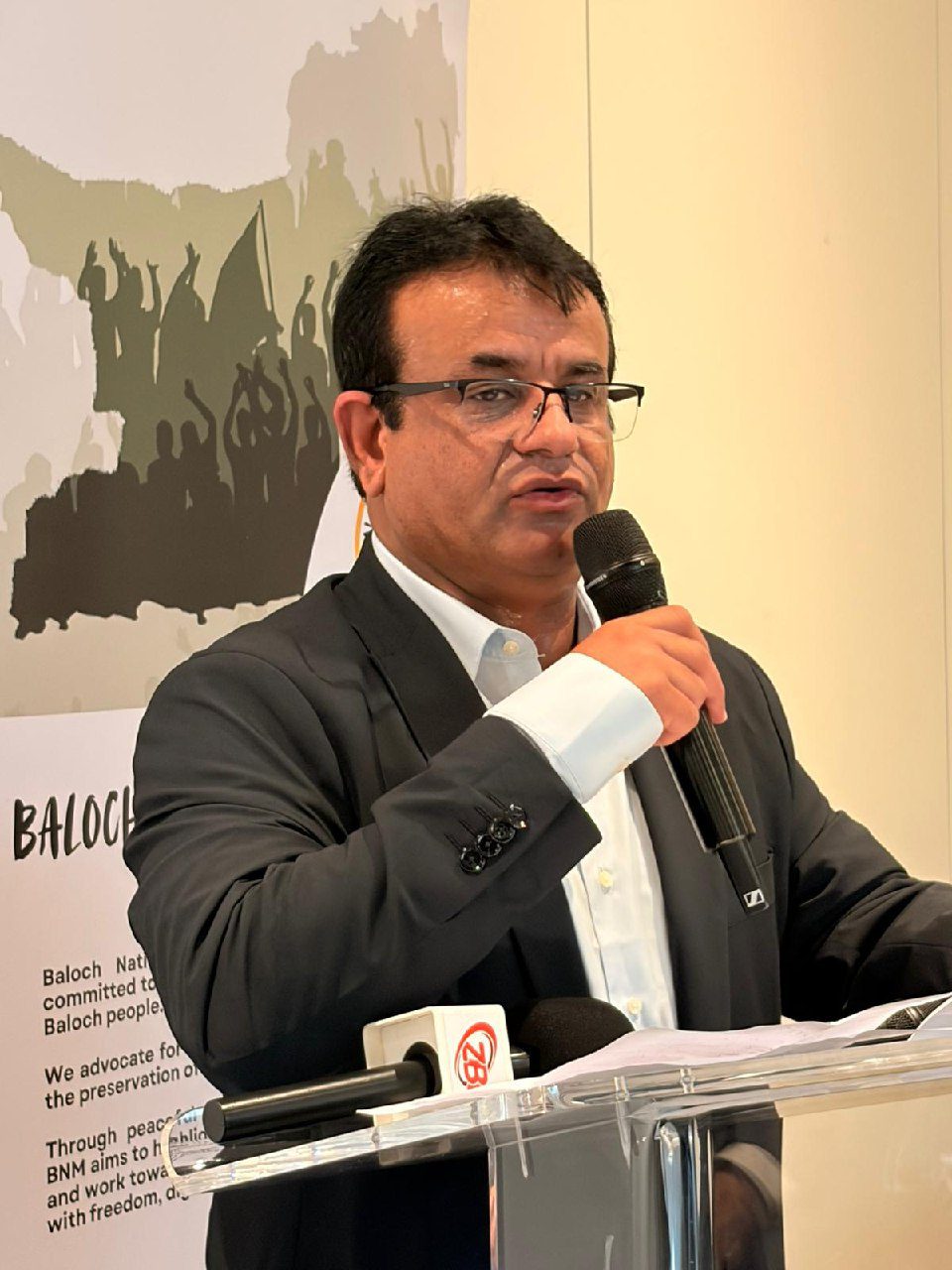
GENEVA: The Baloch National Movement (BNM) organized an international conference during the 61st session of the United Nations Human Rights Council in Geneva titled: “Balochistan: Seventy-Eight Years of Occupation, Human Rights Violations, and the Failure of International Accountability.”
This marked the party’s 11th international conference at the global level, held at the Rousseau Conference Hall of the Royal Hotel Geneva. The event was attended by politicians, analysts, human rights advocates, and experts, serving as an important platform to discuss the political and humanitarian dimensions of the Baloch issue, while promoting international awareness and solidarity.
Addressing the conference, Chairman of BNM Dr. Naseem Baloch stated that they gathered once again to raise their voice against seventy-eight years of oppression, brutality, genocide, denial of national identity, and exploitation of national resources against the Baloch people. He noted that they convened in Geneva, home of the United Nations, to mark a significant milestone in their struggle for national freedom.
Dr. Naseem Baloch referenced the hall’s namesake, philosopher Jean-Jacques Rousseau, who said, “Man is born free, but everywhere he is in chains.” He said the Baloch nation remains chained in subjugation. Although not a state today, the Baloch meet all criteria of a nation, having had a state in the past and firmly believing they will have one again.
He emphasized that as Chairman of BNM, it is his responsibility to tell the world that the Baloch nation is sacrificing lives for freedom. They are shedding blood for collective survival. The BNM’s clear objective is the freedom of Balochistan, a fundamental right over their land and for future generations.
Those gathered thousands of kilometers from home remain determined to realize the dream crushed in 1948 through force and violence. The Baloch struggle is not mere protest; it is a case of a living nation enduring torture, deaths, and mutilation of its members.
He condemned Pakistan’s recent policy announcement of collective punishment, clarifying it has been practiced for two decades, targeting leadership and members in attempts to force them to abandon the struggle. Yet, the path to national freedom is irreversible the Baloch nation will not retreat.
“Pakistan has consistently violated its fundamental agreements with Balochistan.” Says Sardar Akhtar Mengal, President of BNP
Sardar Akhtar Mengal addressed the conference, stating that the Balochistan issue is not recent or accidental but rooted in Pakistan’s creation. In 1948, Pakistan’s founder Muhammad Ali Jinnah reached an agreement with Baloch leadership granting autonomy except in foreign affairs, defense, and currency. However, this agreement was broken within months with the arrest of the Khan of Kalat, Mir Ahmad Yar Khan, marking the first violation.
“Human rights statistics reveal the brutality of the Pakistani state.” Says Manzoor Pashteen, PTM
Manzoor Pashteen highlighted that when Baloch raise voices against injustice, they are labeled traitors, and ordinary civilians face killings on their own land. He stated that real data on enforced disappearances and killings reveal the true nature of the Pakistani state.
“Self-determination is a fundamental right of every nation.”Says Mercè Monje
Mercè Monje, Secretary General of UNPO, addressed the conference, explaining that UNPO advocates for nations lacking adequate international representation. She noted the conference’s title reflects occupation and human rights violations at national and global system levels.
Monje explained the international system, including the UN, is state-based, often excluding peoples and nations like the Baloch and Sindhi from meaningful participation in decisions affecting their lives. Denial of participation equates to denial of self-determination, which is the fundamental right of nations to shape their futures.
“Pakistan is a criminalized, militarized, and authoritarian state.” Says Dr. Ayesha Siddiqa
Dr. Ayesha Siddiqa, King’s College fellow and scholar, praised Baloch National Movement’s efforts to unify voices for Balochistan’s cause. She described Pakistan as criminalized, militarized, and authoritarian, with complete military control and increasing brutality.
She called for collective strategy development to envision Balochistan’s future over the next 10 to 15 years.
“Balochistan’s pain is real, and it will be free.” Says Andy Vermaut
Human rights activist and journalist Andy Vermaut spoke of Geneva as a city symbolizing law and justice. He has petitioned the European Parliament to review Pakistan’s GSP status, arguing trade must not come at the cost of human dignity.
He highlighted the role of Baloch women in continuing the resistance amid enforced disappearances, stressing history remembers the disappeared and no occupation or oppression lasts forever.
Anna Lorena Delgadillo-Pérez (UN WGEID)
Anna Lorena Delgadillo-Pérez, a UN Working Group member on Enforced or Involuntary Disappearances, shared her group’s documentation of arbitrary arrests, enforced disappearances, extrajudicial killings, and excessive force in Balochistan, noting a recent increase in such violations.
Gary Cartwright
Gary Cartwright, Editor and Publisher of EU Today, reflected on 64 years of experience, emphasizing the political nature of human rights campaigns. He noted the acceptance of their white paper analyzing Pakistan’s non-compliance with GSP+ obligations by the European Commission’s Directorate-General for Trade, marking progress.
Hidayat Bhutto (World Sindhi Congress)
Hidayat Bhutto expressed solidarity from the World Sindhi Congress, highlighting shared historical, cultural ties and common suffering with Balochistan under state violence and denial of rights.
He condemned forced disappearances, extrajudicial killings, and collective punishment affecting both peoples, citing recent abductions of BNM Chairman Dr. Naseem Baloch’s family as evidence of state repression.
Sherbaz Khan (Awami Workers Party, Gilgit-Baltistan)
Sherbaz Khan drew parallels between Gilgit-Baltistan and Balochistan, citing occupation and exploitation of resources. He expressed full support for BNM’s struggle on behalf of his party and leader Baba Jan, emphasizing the shared global movement for justice and freedom that binds oppressed regions together.
Saqlain Imam (Journalist)
Journalist Saqlain Imam called the Baloch movement a legitimate struggle for freedom. He discussed Pakistan’s continued external influence post-independence and the shared grievances of regions like Gilgit-Baltistan, Sindh, Balochistan, and Pashtun territories.
He highlighted media blackouts in Balochistan, risks to journalists, and the need for international reassessment of engagement with Pakistan’s military. He praised the Baloch people’s determination and declared their struggle the fight of every freedom-loving individual.
“Last year in Balochistan, 1,355 people were forcibly disappeared and 225 were extrajudicially killed.” Says Hatim Baloch, PAANK BNM
Hatem Baloch of human rights organization PAANK presented data documenting 1,355 enforced disappearances and 225 extrajudicial killings in 2025, with continued violations into 2026 including over 21 young people killed in Panjgur.
He called on international authorities to investigate, pressure Pakistan to end abuses, suspend Pakistan’s GSP Plus status, and support affected families.
Dr. Shalee Baloch, central organizer of the Baloch Women Forum (BWF)
Dr. Shalee Baloch, central organizer of the Baloch Women Forum (BWF), addressed the UN 61st Human Rights Council session, condemning ongoing abuses including enforced disappearances and extrajudicial killings.
She urged higher state authorities and international bodies, including the UN, to take Baloch concerns seriously and called on media to report factually and directly from the ground, emphasizing collective responsibility.
The conference was moderated by Saleem Baloch and Mehra Baloch.
This conference underscored the enduring crisis in Balochistan, highlighting decades of human rights violations and the unyielding determination of the Baloch people in their quest for freedom and justice.