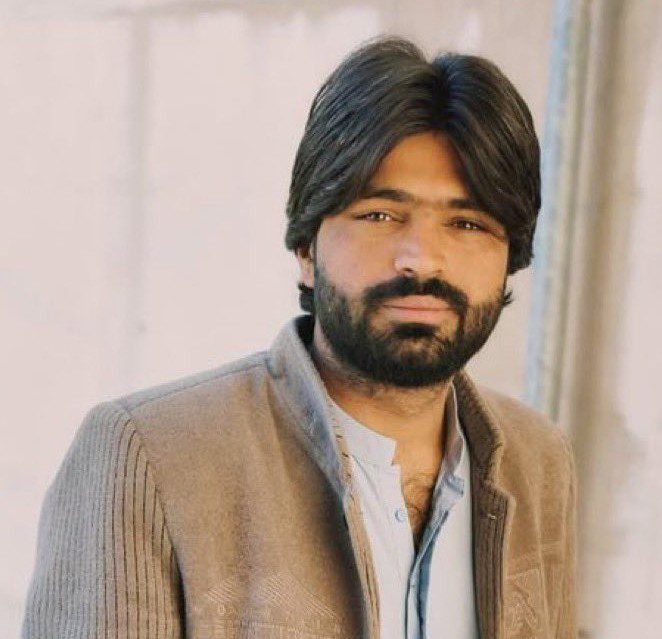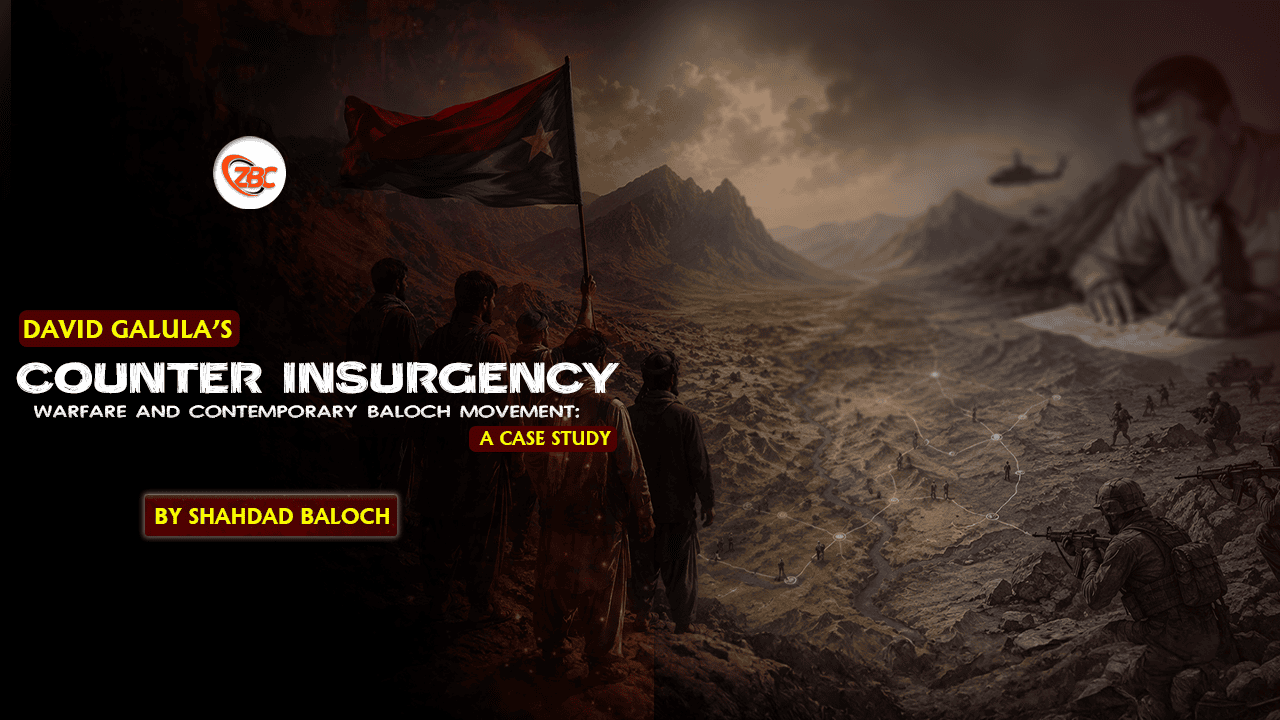
WRITER; SHAHDAD BALOCH.
The term ‘counterinsurgency’ means military or political action taken against the activities of guerrillas or revolutionaries However, counterinsurgency itself has no independent existence it only emerges in response to an ongoing insurgency. This raises an important question: What is an insurgency?
David Galula the author of the book “The counter insergencey warfare, Theory and Patrice” and a military officer, defines that “an insurgency is a struggle between insurgents and the government for the support of the civilian population, which serves as the sea in which the insurgents swim.” He reminds us that “Counterinsurgency cannot achieve much if the population does not feel protected against the insurgents.” In other words, when civilians feel unsafe, they are likely to side with the insurgents. Therefore, a successful counterinsurgency effort must focus on controlling the population and separating them from insurgents to prevent their influence from spreading.
However, the key to success in counterinsurgency warfare lies in gathering intelligence from the local population to identify the enemy. The most fundamental source of intelligence is independent individuals who provide reliable information. He also asserts that controlling the population in any given region can weaken and ultimately defeat the insurgents.
Revolutionary War: Nature and Characteristics
According to David Galula a revolutionary war is an internal conflict within a state that extends over a long period. He differentiates a revolutionary war from a conventional war, explaining that in a conventional war, either side can initiate hostilities, while a revolutionary war is always initiated by the insurgents. The role of the counterinsurgent is to sabotage the war that the insurgents have begun.
The primary objective of a revolutionary war, or an insurgency, is to gain control over the population. Galula argues that revolutionary wars are also known as political wars because, for the insurgents, politics serves as an instrument of war. While military action dominates during the conflict, politics resurfaces as the primary tool once the fighting ends. In contrast, a conventional war is primarily a military conflict, supported by diplomacy, propaganda, and economic pressure as secondary means to achieve strategic goals.
Because the objective of a revolutionary war is to gain control over the population, operations are designed either to win the people’s support (for the insurgents) or, at the very least, to keep them submissive (for the counterinsurgents). This makes revolutionary war fundamentally political in nature.
The Prerequisites for a Successful Insurgency
According to Galula, an insurgency can only succeed if the insurgents manage to gain the support of the population. This means that the primary focus of an insurgency must be on winning over the people. Conversely, the counterinsurgents’ main objective is to isolate the insurgents from the population.
In a revolutionary war, both insurgents and counterinsurgents compete for the support of the people. Whoever successfully secures this support ultimately wins the war. Therefore, it is crucial for insurgents to sever all connections between the population and the counterinsurgents while building strong relationships with the people themselves.
When comparing Galula’s strategy with the situation in Balochistan, we see that the state has employed similar tactics. Pakistan’s primary approach to undermining the Baloch nationalist movement is to gain the support of the population. The state has surrounded itself with informants who report on every movement and activity within Baloch society. On the other hand, Baloch Samachar is also focused on winning the people’s support, engaging in as many activities as possible to strengthen their influence and we can say that they have been successful to serve there idea or influence to the Baloch population.
Areas in an Insurgency
David Galula argues that in any insurgency, there are always three types of areas: Red, Pink, and White. These categories help define the level of insurgent control over a given territory.
Red Area: According to Galula Red Area is the area which is completely under the control of the insurgents. In this area, the insurgents dominate the population, operate freely, and use it as a safe haven for planning and launching attacks. Simply, in red area the state has no presence, and the insurgents feel secure and operate freely.
When comparing Galula’s concept of the Red Area to the ongoing Baloch insurgency, we see that certain regions in Balochistan, such as Mashkay, Bolan, and Komazi and others area, are largely under the dominance of the Baloch Samachar (insurgent fighters). In these areas, the insurgents openly interact with the local population, gain their support, and maintain a stronghold.
Pink Area: The Pink Area is a contested zone where the insurgents are actively trying to expand their control but do not yet have full dominance. Guerrilla warfare is common in these areas, with insurgents conducting frequent attacks to weaken the state’s authority and strengthen their influence.
Currently, in Balochistan, several regions can be classified as Pink Areas. Cities such as Turbat, Khuzdar, Quetta, Gwadar , Mustang and others area have seen an increase in insurgent activities. The Baloch Samachar are engaging in guerrilla warfare in these locations, attempting to gradually establish their dominance. The growing frequency of their attacks and operations suggests that they aim to turn these areas into Red Areas over time. Hence, there are being successful in it,
White Area: The White Area refers to regions that are still under full state control and have not yet been significantly affected by the insurgency. There is little to no insurgent activity, and the state retains administrative and military dominance.
In the context of Balochistan, there is no such area which should be considered white, but the region, like Ormada, can be relate as White Areas. This is the area which have not yet experienced major insurgent activity. However, the Baloch Samachar are likely working on strategies to extend their influence into these regions in the future.
Hence, Galula’s classification of Red, Pink, and White Areas provides a useful framework for analysing the Baloch movement today. The Red Areas serve as strongholds for insurgents, the Pink Areas are battlegrounds where they seek to expand, and the White Areas remain under government control but are potential future targets. Understanding this dynamic helps in assessing the progress and strategy of the insurgency as it evolves.
Role of Propaganda in Insurgency:
Propaganda plays a crucial role in insurgency and is considered a one-sided weapon. Galula argues that for insurgents, propaganda is a powerful tool because they do not need to provide evidence for their claims. In contrast, counterinsurgents must substantiate their claims with evidence, making propaganda a secondary weapon for them—useful only when intended to inform rather than deceive. A counterinsurgent cannot effectively cover up failures or fabricate victories through propaganda alone. Therefore, if insurgents can execute an effective propaganda campaign, they have a significant advantage in winning the war. However, in war conflict zone propaganda can be describe in two category known as centralized media and decenteziled media.
Centralized media and Decenteziled media
Centralized media: Centralized media platforms are controlled by a single entity which means that the Media systems where control is concentrated in the hands of a few large organizations or the state itself. However, in the centralized media system whatever propaganda is being done it is decided by the system itself and they do that propaganda which benefit their ideas and narration to control the people mind.
Moreover, in the insurgency the centralised media has always played in important role to counter the insurgency and build narration for the counter-insurgency and sabotage the ideas of insurgents in the area. It also hides the reality. So, if we take the example of Pakistan regarding the centralized media system that we can see in Pakistan that ‘centralised media’ means the PTV (Pakistan Television Corporation) and Radio Pakistan (Pakistan Broadcasting Corporation), which are directly control by the state itself. And these media channel has always have been involved in making a very positive narration for Pakistan around the world. So, on the other hand we can see the private centralised media channels in Pakistan such as BOL news, ARY news, GEO news and other which never show the true reality of Pakistan especially about the Baloch issue or the Baloch insurgency group fighting the motherland. In Pakistan the centralised media is totally controlled by the state itself and nothing can be propagated until and unless it has been verified by the state itself.
Decentralized media: Decentralised media means distributing control across multiple users and independent servers, giving users more control over their data and content. Decentralized social media platform is basically the opposite of centralised social media in the sense that there is no central entity or authority that makes decisions on the platform instead the decisions are made by the users of the platform. However, in a decentralised media system the users can produce, share, and consume content freely with the help of social media platform. So, in insurgency the decentralized media is always been helpful for the insurgent Group to build the narration to the public and to gain the support of the population. So as I already said that the centralised media always cover the voice of insurgent and therefore the insurgent need a strong decentralised system the sabotage the narration of the centralised media system.
Moreover, is I above give the example of Pakistan media system today in Baluchistan we can see the so-called ‘centralised’ media system is always wanted to cover the complete voice Baloch people but the Baloch has made for them a strong decentralized media system due to which today their voice has reached internationally and the propaganda of Baloch army struggles has also shown the world that they are strong enough to defect any colonial power on their motherland.
The Operation by the counter insurgent:
Galula describes the process of the operation by the counter-insurgent to sabotage the insurgency in the following steps:
The first step: Destruction or Expulsion of insurgent forces
According to Galula in the first step it is necessary for the counter-insurgent to destruct or to expel the Guerrilla force within their selected area. However, the first operation does not mean that the guerrilla force will be completely destroyed; rather, this is only done to prepare themselves for the coming counterinsurgency actions:
Before going to the tactics Galula defines threes units of the counterinsurgency forces which are necessary to be understood: mobile unit, plus unit and Static unit.
Mobile Unit: Galula defines that mobile unit is a unit of counterinsurgency that is a fast-moving military units used to pursue insurgents, conduct patrols and respond quickly to threats. However, mobile unit main purpose is to maintain pressure on insurgents by keeping them on the move or to conduct search and destroy operation. Hence, the mobile unit of counterinsurgency is high mobility, always play their role in tactical offensive operations and often work outside of populated areas.
Static Unit: static unit mean the units which are stationed in fixed positions within key population centers or strategic points. Their primary role is to provide security and build stability in these areas. However, it main purpose is to hold and protect territory that has been cleared or to maintain order and prevent the return of insurgents. We can say that it is defensive posture or long term presence which main focus is on the protection of civilians from the galleria connection.
Plus, Unit: according to Galula plus unit is not a separate unit but rather an augmented version of a static unit. It includes not just the soldiers but also the civil administrators and development personnel. However, it purpose is to combine security with development and governance , to implement hearts and minds campaigns by addressing civilian needs or to support nation-building and the legitimacy of the government. Hence, it is a multidisciplinary unit which integrated approach such as security, governance and development for winning the support of the population. So, these are the units of the counter-insurgent when they go for the operation against the insurgent.
Tactics for this operation:
In the tactics it would be better to describe how these unit work. According to Galula the mobile units plus unit earmarked to stay in the area in order to reinforce whenever static units were originally there or suddenly concentrated around the area. They start operating from the outside in, aiming at catching the guerrilla in a ring. So, it the same time, the unit garrisoning the adjoining areas are ordered to intensify their activity on the periphery of the selected area. Moreover, the sweep is next conducted from the inside out, aiming at least at expelling the Guerrillas. Hence, the overall operation is finally broken down into serval small scale ones. All the static units, the original as well as the new ones are assigned to their permanent sector apart of the mobile unit operates as a body, centrally controlled and the rest is lent to the sectors. All the forces work on what is left of the guerrillas after two earlier sweeps. Hence, the operation is supplemented during this step as in all the other by tactical information and psychological warfare diverted at the insurgent, the counter-insurgent’s own forces and the population.
The second step: Deployment of the Static Unit
Complete elimination of the guerrillas by military action being practically impossible at this stage, remnants will always manage to stay in the area, and new recruits will join their ranks so long as the political cells have not been destroyed. Here, the mobile force’s main focus will be to control the population so that the guerrilla’s forces do not come back in strength from outside and static unit will be focusing to fight against the guerrillas and sabotaging them completely. However, the purpose in deploying static units is to establish a grid of troops so that the population and the counterinsurgent political teams are reasonably well protected and so that the troops can participate in civic action at the lowest level, just where civilian political personnel is insufficient in number. The area will be divided into sectors and subsectors, each with its own static unit.
Moreover, the subdivision should be carried down to the level of the “basic unit of counterinsurgency warfare”, the largest unit whose leader is in direct and continuous contact with the population. This is the most important unit in a counterinsurgency operation, the level where most of the practical problem arise, where the war is won or lost. the size varies from case to case and in each case with the situation: the basic unit may be battalion or a company initially, a squad or even a rural policeman at the end of the process.
The third step: Contact with and control of the population
The main objectives are pursued in this step:
- To re-establish the counterinsurgent’s authority over the population.
- To isolate the population as much as possible, by physical means, from the guerrillas.
- To gather the necessary intelligence leading to the next step: elimination of the insurgent political cells.
This is the most critical step in the process because of its transitional character, moving from emphasis on military operation to emphasis on political ones, and because it is combines a heavy burden of both. The main centre of interest switches now to the level of the basic unit work, where the real battle takes place. However, in this step the following are some basic elements which are concerned by the counterinsurgent.
Contact with the population: this complete operation, contact with the population, is actually the first confrontation between the two camps for power over the population. The battle happens because the population, which was until recently under the insurgent’s open control and probably still is under his hidden control through the existing political cells, cannot cooperate spontaneously ever if there is every reason to believe that majority is sympathetic to the counterinsurgent. The inhabitants will usually avoid any contact with him. There is a barrier between them and the counterinsurgent that has to be broken and can be broken only by force. Whatever the counterinsurgent wants the population to do will have to be imposed. But the population must not be treated as an enemy.
Control of the population: control of population begins obviously with a thorough census. Every inhabitant must be registered and given a foolproof identity card. Family booklets should be issued to each household in order to facilitate house-to-house control, and family heads made responsible for reporting any change as it occurs. This main purpose is to disconnect the insurgent from the population and to have a check and balance of the population to be controlled. However, if we compare the same policy of Galula’s with the Balochistan it can be clearly seen in the remote area, like Maskay, has been directly controlled by the military forces. After 2013 in this area, every citizen was given an identity card by the forces to prove their identity with the same card while entering or leaving the area. Even a person who has lost the card or has forgotten it at home while leaving is treated with hard punishment. So, to control the population means to isolate guerrillas geographically from the population.
Protection of the population: protection of the population means the population shall be protected completely from the insurgents. The counterinsurgent cannot achieve much if the population is not and does not feel protected against the insurgent. So, in this complete operation, the main target is the population from both side (insurgent group or counterinsurgent group). Whoever is above them be possible to control the population will win the war.
Intelligence collection: intelligence collection means the counterinsurgent has to collect the complete data of an area such as what the population is doing, who in the population is connected with the insurgent group, getting information about the insurgent group from the population and more data like this is the complete focus of the counterinsurgent group. However, when an organization is set up to collect intelligence than intelligence is bound to flow in, either because informers come spontaneously to the organization or because it goes after informers; the only real problem is how to prime the pump and hasten the flow.
Starting to win the support of the population: implementing political reforms, if they have been conceived and announced by the government would be premature at this stage. The time will be right when insurgent political cells have been destroyed and when local leaders have emerged. So, in this political filed, the task of the counterinsurgent leader is to discover what reforms are really wanted and to inform the higher echelons, or to determine whether the announced reforms conform with the popular wish. However, the same policy can be trace in Balochistan after the crackdown on the political leaders from 2009 to 2017. At this time, we have seen that one side the state was used hard power to sabotage the Baloch nation movement by targeting the Baloch political leaders but on the other side making soft policy to get the support of the population by facilitating them. And these policies can be trace such as making roads or giving jobs or scholarships to the Baloch youth in the universities of other provinces of Balochistan. This complete operation was the programme of counterinsurgent policy for the Baloch people to change their narration and make them far away from the movement, but the state doesn’t achieve much from this.
The fourth step: Destruction of the Insurgent Political Organization
In the fourth step, Galula emphasized about the necessity for eradicating the insurgent political agents from the population is evident. But here he raises a question of how to do it rapidly and efficiently, with a minimum of errors and bitterness. He argues that for this there should be direct operation against these political organizations to make them far away from the guerrillas. If it is necessary, then arrest the men who are involved in political activities. This operation is done by the police according to Galula, but if the existing police cannot be trusted, then a special police force must be created for the purpose, as we currently can see in Baluchistan in the shape of the CTD, where the Baloch political leaders are being targeted and killed and some, like the leadership of BYC are behind the bars.
But here again arises a question: in this process, who can guarantee that mistakes will not be made and common people wrongly arrested? One of the insurgent’s favourite tricks, indeed, is to mislead the counterinsurgent into arresting people who are hostile to the insurgency. Assuming that only the right men have been arrested, it would be dangerous and inefficient to let them handle and interrogated by amateurs. So all these reasons demand that the operation be conducted by professionals, by an organization that must in no way be confused with the counterinsurgent personnel working to win the support of the population. So, the counterinsurgent personnel participate in intelligence acquisition, but only the police or the special force which has been created should deal with the suspected agents. Moreover, if the police are ready to do a purge, then this purge should be based on two factors. The first, whether the police have enough intelligence to make a purge successful. And secondly, whether the purge can be followed through.
However, in the red areas, the intelligence situation with regard to the insurgent political organization conforms usually to the following pattern. The boss and the top cell members are too heavily committed to the insurgency to be expected to change their attitude readily and to talk freely when arrested. So, when arrested singly or in small groups, do not talk, either, because of the that subsequent counterinsurgent moves against the political agent would be traced to their disclosures.
Conclusion:
To conclude, the state has attempted to implement many of the counterinsurgency principles associated with David Galula in order to weaken the Baloch movement, but these efforts have not fully succeeded. Today, the movement appears deeply rooted, making it difficult for the state to dismantle it easily. The movement feels that they have experienced long-standing political, economic, and social grievances, which have contributed to continued resistance.
According to Galula, counterinsurgency requires precision and consistency, with little room for error. However, critics argue that state policies have sometimes been inconsistent or counterproductive, which may have unintentionally strengthened the movement rather than weakening it. At the same time, the political awareness among Baloch youth has increased, and the movement has been more organised.
It is also important to note that today the nature of the Baloch movement has evolved. Earlier, the movement relied largely on traditional guerrilla warfare, which was typically operated in remote and mountainous regions with a slow process. But currently there has been a shift toward urban-based tactics (urban warfare), where major attacks are occurring in cities or populated areas with a large process, often designed to gain attention and influence public perception.
Hence, all these developments came to the Baloch Movement at that time, where an internal dynamic came to the movement, like the movement today has been totally controlled by the ground leadership itself. This the beauty of Baloch movement: today the command and the control of the war have been totally in the hands of the ground leadership, which has shaped the movement completely. The Baloch movement today has major attack such as Operation Sob of BLF and Darra-E-Bolan, Herof 1, Herof 2 and other such large attacks of BLA and has been completely successful in severing their narrations to the target audience that has been set by them.
In addition, information and narrative building have become increasingly important. Like many modern conflicts, the struggle is not only physical but also psychological. Both sides attempt to shape public opinion and influence how events are interpreted by local and wider audiences. In this context, communication strategies play a key role.
Overall, tracing the Baloch movement from 2000 to the present, various tactics of the state, such as military operations, attempts to isolate armed groups from local populations, and crackdown actions against political organisations which were made to counter the movement, have been the cause of Baloch suppression, and day by day this movement is going to get stronger as well.