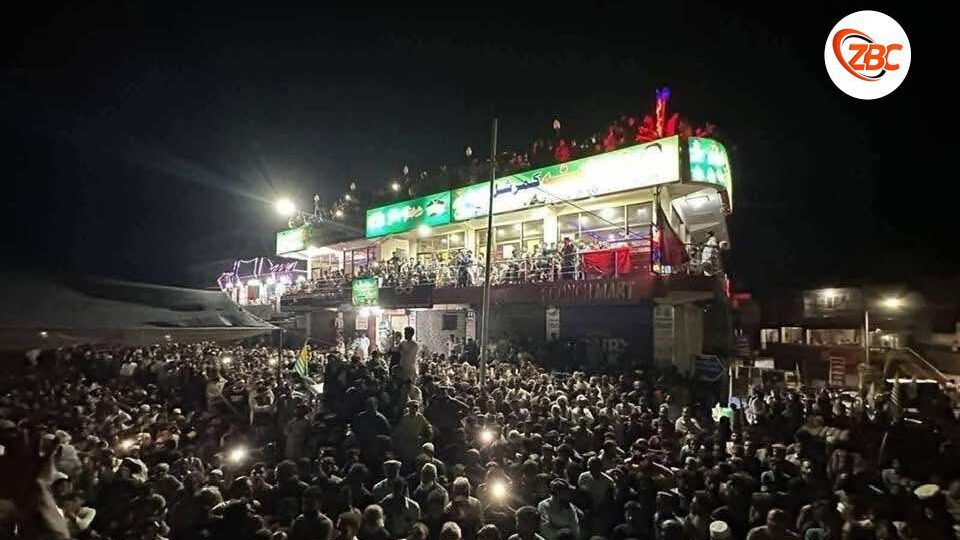
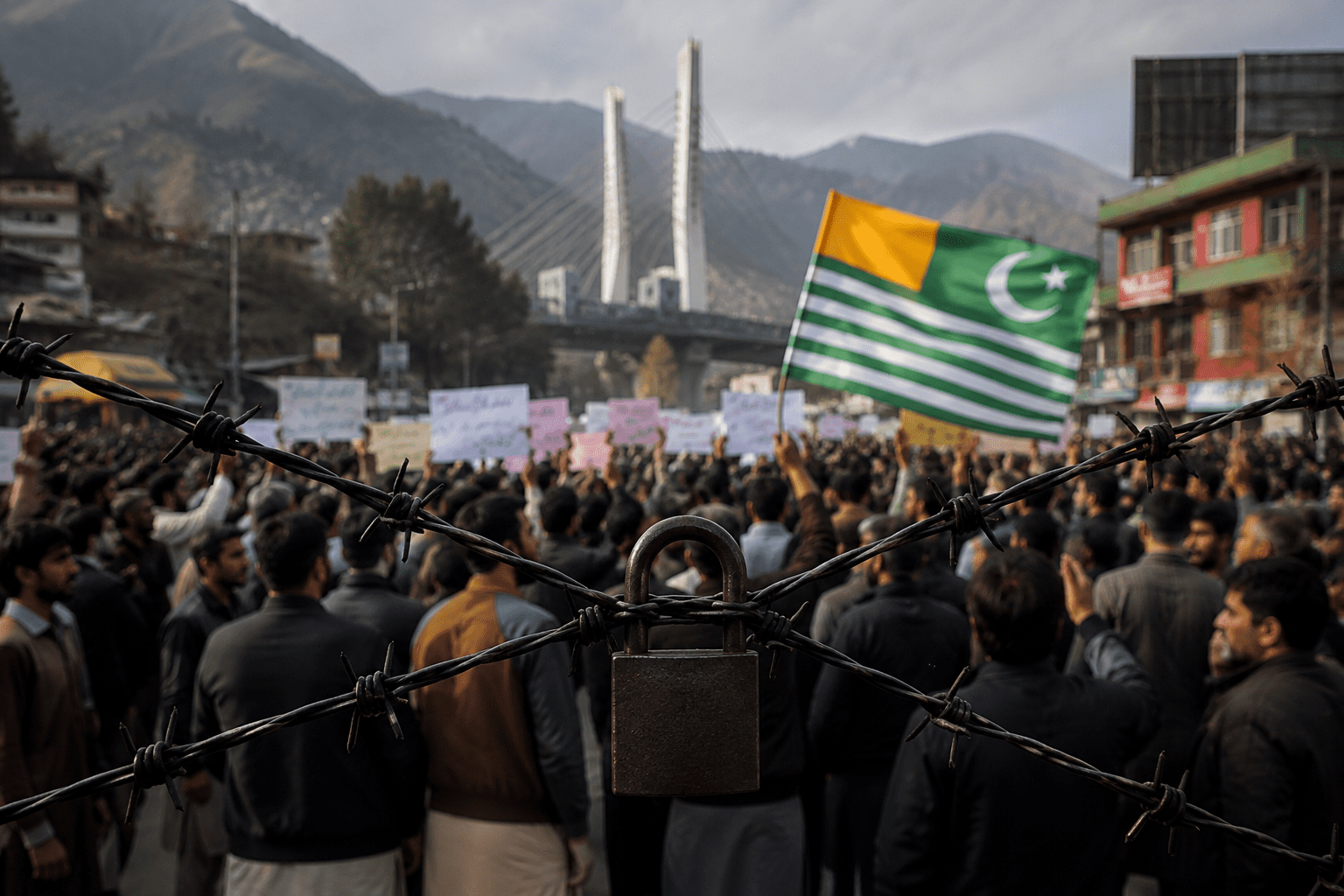
MUZAFFARABAD: In a dramatic escalation of political tensions in Pakistan-administered Kashmir, the government of Azad Jammu and Kashmir (AJK) has officially banned the Jammu Kashmir Joint Awami Action Committee (JAAC), placing it under the First Schedule of the Anti-Terrorism Act, effectively outlawing its activities across the region.
The decision comes just days before the group’s planned June 9 long march and indefinite shutdown, a protest campaign that had already triggered widespread concern over possible unrest in the Himalayan region.
Government justification: “threat to public order”
According to an official notification, authorities accused the Jammu Kashmir Joint Awami Action Committee (JAAC) of creating unrest and instability, inciting public disorder and intimidation, and disrupting peace ahead of elections. The government further alleged that the group encouraged shutdowns and mass mobilisation that could potentially paralyse state administration. Officials said the ban was necessary to prevent what they described as “anarchy-like conditions” as the region approaches a sensitive electoral period. Following the decision, security agencies were placed on high alert, with additional forces reportedly deployed across major districts including Muzaffarabad, Mirpur, Kotli, and Rawalakot.
What is JAAC?
The Jammu Kashmir Joint Awami Action Committee (JKJAAC) is a civil society–based alliance formed in 2023, bringing together traders, transport unions, lawyers, students, and local activists. It emerged as the most influential grassroots movement in Azad Jammu and Kashmir (AJK) after mobilising large-scale protests over rising electricity prices, expensive wheat and flour, inflation and unemployment, alleged elite privileges enjoyed by politicians and bureaucrats, and the distribution of hydropower revenues generated from local resources. The movement gained national attention following widespread protests in 2024, when large-scale demonstrations compelled the government to announce subsidies and policy concessions on essential commodities.
From economic protests to political confrontation
What began as an economic rights movement has gradually evolved into a politically sensitive force challenging the structure of governance in Azad Jammu and Kashmir (AJK).
At the centre of the dispute is the JAAC’s set of demands, which include electricity at production cost from local hydropower projects, the removal of 12 refugee seats in the AJK Legislative Assembly, an end to elite privileges and bureaucratic perks, and the implementation of a 38-point reform charter agreed in 2025.
The government, however, maintains that these demands carry constitutional implications and cannot be implemented unilaterally outside the established legal and institutional framework.
Trigger for escalation: stalled agreement
Tensions escalated after a 2025 agreement between JAAC representatives and government authorities began to unravel, with both sides accusing each other of failing to implement agreed commitments.
In response, JAAC issued an ultimatum, warning that if its demands were not met by May 31, 2026, it would launch a region-wide shutdown and march toward Muzaffarabad on June 9.
The government subsequently responded with the ban, describing the planned mobilisation as a serious threat to stability and public order.
Political impact
Analysts say the ban marks one of the most significant confrontations between the state and a civil society movement in AJK in recent years.
Key implications include the possibility of arrests of JAAC leadership, the risk of mass protests despite the prohibition, a further breakdown in negotiations with Islamabad, and heightened political tensions ahead of upcoming elections.
Some observers caution that the move could intensify rather than contain unrest, as JAAC continues to enjoy strong grassroots support across trading networks and urban centres.
What happens next?
Despite the ban, JAAC-linked networks have not formally withdrawn their protest call. Local sources indicate that mobilization efforts continue quietly, with the possibility of renewed confrontation in early June.
Government officials insist dialogue remains open, but insist the ban will stay in force unless “law and order guarantees are restored.”