Two decades of shifting narratives in Balochistan, while the conflict remains unresolved
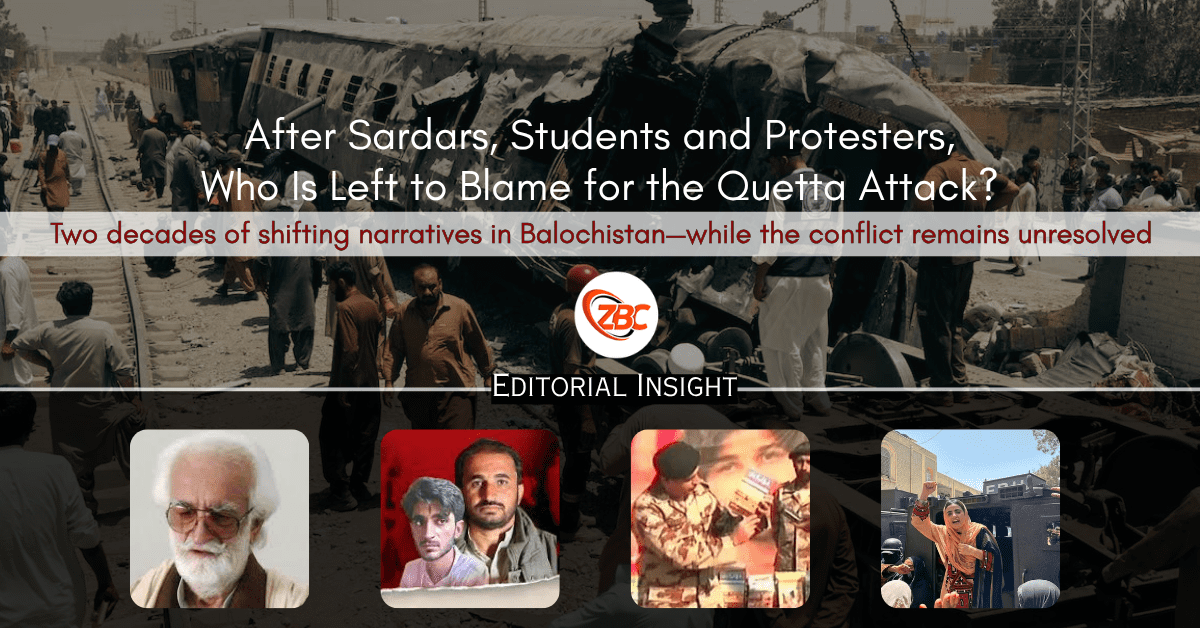
For nearly two and a half decades, the Pakistani state’s approach to Balochistan has followed a familiar pattern: when unrest deepens, a new face is found to carry the blame. But with the recent Quetta attack, after so many have already been blamed, silenced, imprisoned, or killed, who is left for the state to accuse now?
In the early years of the armed movement, responsibility was placed on the shoulders of the “three bad sardars”, a political narrative built around tribal chiefs accused of obstructing development and fueling rebellion. The conflict was framed as the work of a handful of tribal leaders resisting the writ of the state.
After the killing of Akbar Bugti in a military operation in 2006, that narrative began to collapse. His death became a turning point in Balochistan’s conflict and is widely seen as having intensified the insurgency across the province. The blame then shifted from sardars to “angry Baloch nationalists”, particularly an educated and politically mobilized youth.
As enforced disappearances expanded and reports of extrajudicial killings mounted between 2008 and 2014, a generation of Baloch students, writers, and political workers became the focus of state suspicion. Human Rights Watch documented a persistent pattern of disappearances in which Baloch activists and students were allegedly targeted by security agencies. Among the most emblematic cases was the abduction and killing of Ghulam Mohammad Baloch, a senior leader of the Baloch National Movement (BNM), along with his companions Lala Munir Baloch and Sher Mohammad Baloch, whose bodies were found days after they were taken from a lawyer’s office in Turbat in April 2009. Their killings became a defining moment in Balochistan’s political memory. The years that followed were marked not only by disappearances but also by the discovery of mass graves, most notably in Tootak, Khuzdar, in 2014, where decomposed bodies were recovered, deepening fears among families of the disappeared and intensifying demands for truth and accountability. Many student leaders vanished. Others were killed. Campuses became spaces of fear rather than debate.
Then came another explanation. The blame shifted again — this time toward ideas. Revolutionary literature, political texts, and nationalist writings were increasingly portrayed as the source of radicalization. Books were monitored. Student circles were watched. The debate itself became suspect.
From 2019 onward, with the emergence of mass rights-based mobilizations led by the Baloch Yakjehti Committee (BYC), the political landscape transformed. The language was no longer primarily armed resistance; it was rights, justice, missing persons, dignity, and accountability. Women came to the forefront. Families of the disappeared occupied public space. Mothers became the face of resistance. The state’s blame shifted once again, toward peaceful social movements and their leadership.
Now, much of that leadership is jailed, detained, or under severe pressure.
The latest suicide attack in Quetta raises a question that cannot be answered through another arrest campaign or another press conference.
If the sardars were responsible, and then the students were responsible, and then the books were responsible, and then the peaceful protesters were responsible, after killing and detaining them all, who will the state blame now?
This is no longer only a political question. It is a question about the failure of a decades-long policy.
A conflict cannot be resolved by endlessly changing the accused while refusing to confront the causes beneath it: political exclusion, enforced disappearances, militarization, denial of representation, and the deep alienation felt across generations in Balochistan. Reports over the years continue to show that enforced disappearances remain central to the province’s human rights crisis, while militancy has simultaneously evolved rather than disappeared.
The Quetta attack is not only a security incident. It is also a political mirror.
It reflects back a difficult reality: despite years of military operations, censorship, arrests, disappearances, and the silencing of both armed and peaceful voices, the conflict in Balochistan remains unresolved.
States can imprison leaders. They can ban books. They can disperse protests. They can accuse one group after another.
But blame is not policy.
And without political dialogue, accountability, and a willingness to address the roots of Balochistan’s grievances, new names may continue to be blamed, while the crisis itself continues unchanged.