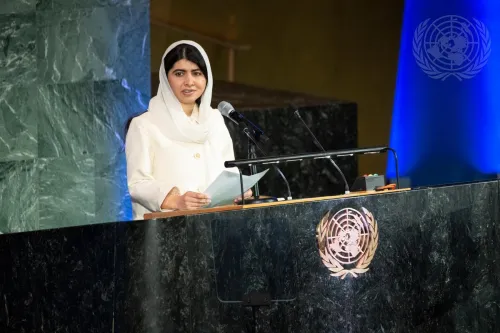
LONDON: Nobel Peace Prize laureate Malala Yousafzai has strongly condemned the life imprisonment sentence handed to Baloch human rights activist Dr. Mahrang Baloch, calling for her immediate release and drawing direct parallels between the current crackdown and a long historical pattern of persecution against women who dare to speak truth to power in Pakistan.
In a statement on social media platform X that quickly drew widespread international attention, Malala said plainly and without qualification: “Mahrang Baloch should not be in prison.”
At the heart of Malala’s statement was a deeply personal and human appeal on behalf of the women and girls of Balochistan, who she said had suffered for years as their male family members were routinely arrested and forcibly disappeared.
“They deserve the life that everyone deserves,” Malala said, painting a picture of ordinary family life denied to thousands across Balochistan. “Daughters who can go to school, fathers who come home at night.”
The simplicity and directness of the appeal cut through the legal and political complexity surrounding the case, framing the issue not as a matter of terrorism or national security but as a fundamental question of human dignity and the right to a normal life.
Malala extended her solidarity beyond Dr. Mahrang Baloch to all women in Pakistan who face harassment, abuse and imprisonment for speaking out.
“I stand with my sisters in Pakistan who face harassment and abuse, who are imprisoned for speaking out,” she said.
In doing so, she placed the Mahrang Baloch case within a broader and deeply rooted pattern of state persecution of Pakistani women who challenge authority. She specifically named Imaan Mazari as another contemporary example of a woman being targeted for her voice.
In one of the most powerful passages of her statement, Malala drew a direct historical line connecting the persecution of Dr. Mahrang Baloch to some of Pakistan’s most celebrated and respected women activists and leaders of previous generations.
“This is not new throughout our history women like Asma Jahangir, Farida Shaheed, Khawar Mumtaz, Hina Jilani and even Fatima Jinnah suffered persecution for standing up,” she said.
By invoking the names of Asma Jahangir Pakistan’s most celebrated human rights lawyer who herself faced death threats, house arrest, and persecution alongside the founding mother of the nation Fatima Jinnah, Malala made a sweeping and historically grounded argument that the silencing of women activists in Pakistan is not an aberration but a recurring feature of the state’s relationship with dissent.
“Today, it is Imaan Mazari and Mahrang Baloch,” she added, completing the arc from history to the present moment.
Malala also directed pointed criticism at the judicial process itself, questioning the priorities of Pakistan’s anti-terrorism court system.
“Rather than addressing the horror of forced disappearances, the anti-terrorism court is targeting those who speak out against the oppression,” she said.
The observation struck at the central contradiction that human rights organisations have repeatedly highlighted that the legal machinery being used to prosecute Dr. Mahrang Baloch is the same machinery that has failed to address the thousands of enforced disappearances that originally motivated her activism.
Malala concluded her statement with a clear and unambiguous demand: “Mahrang and her fellow activists must be released.”