
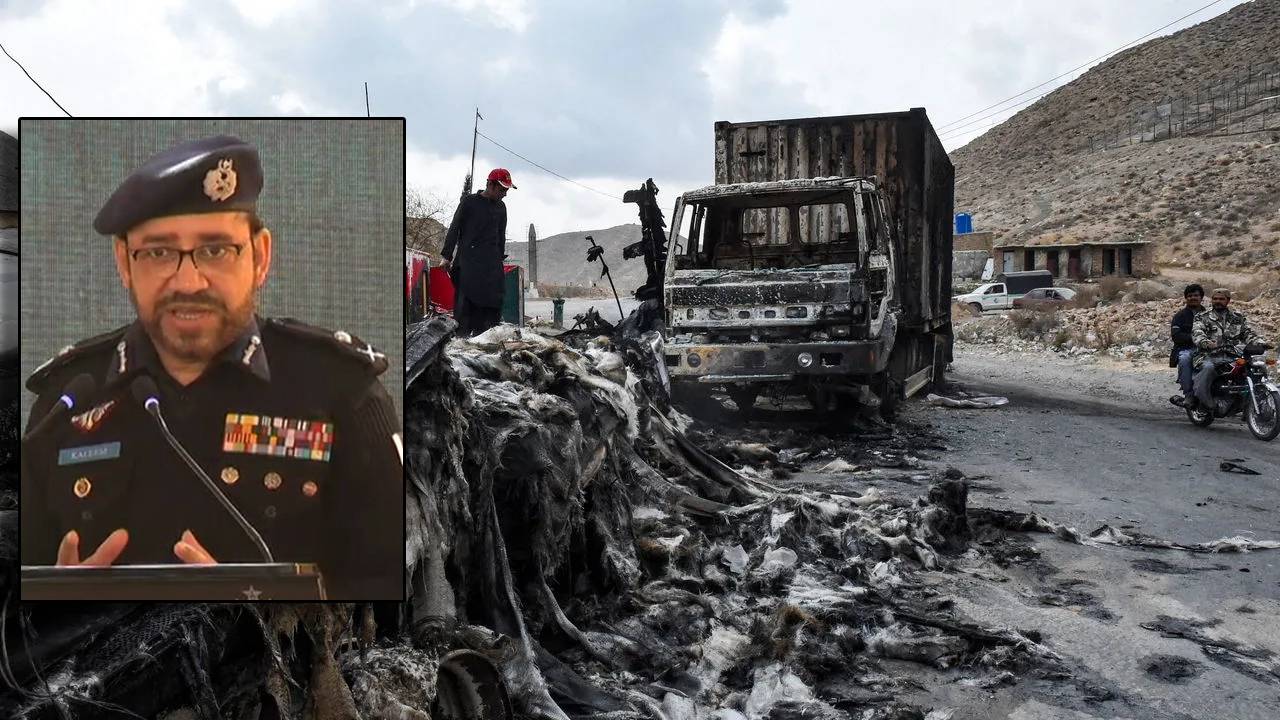
ISLAMABAD: A former federal secretary, inspector general of police, and UN police commissioner has called for a fundamental rethink of Pakistan’s approach to Balochistan, arguing that decades of security‑centric policies have failed to deliver lasting peace.
In an article originally published by Arab News PK, titled “I served in Balochistan. It’s time to admit what isn’t working,” Dr. Syed Kaleem Imam, who joined the Police Service of Pakistan in 1988 and later served officially in Balochistan, recounts his experiences in the province and reflects on how a prolonged conflict has taken root.
Dr. Imam’s first posting as ASP was in Ziarat, Balochistan, a peaceful district with just two police stations serving a close‑knit community. Newly married at the time, he jokingly referred to it as his “honeymoon posting.” Ziarat also introduced him to its ancient juniper forests, whose trees grow only by inches over many years and can stand for centuries. Their strength, he notes, comes from deep roots and continuity.
He recalls learning an important lesson during the 1990 general elections: in communities where people know one another and relationships run deep, hidden actors find it much harder to manipulate events. Yet, while the junipers grew patiently, mistrust took root among people and eventually hardened into the insurgency seen today.
Over the following decade, Dr. Imam watched Balochistan change. What had once been a routine law‑and‑order challenge gradually became a prolonged conflict with national and regional dimensions. He remembers the kidnapping of the then deputy commissioner of Ziarat by Mullah Salam, known as Rocketi, and, years later, the appalling destruction of the Quaid‑e‑Azam Residency. After every major incident, he writes, the official message remained the same: militants had been eliminated, yet violence kept returning, often in new forms and with greater intensity.
“Peace will not come when the last militant is killed. It will come when every citizen believes the state belongs to them,” Dr. Imam emphasizes.
He identifies the operation against Nawab Akbar Bugti as another turning point. Whether one agreed with Bugti or not, Dr. Imam notes, he was an aging tribal leader whose political influence was already fading. His death, however, united many who had previously been divided. What followed, he argues, was an approach that relied more on force than on rebuilding political trust and genuine local institutions.
Nearly two decades later, he says, Pakistan must ask itself an uncomfortable question: if a security‑centric strategy has not delivered lasting peace, why does the state continue to rely on it instead of pursuing a politically inclusive strategy built on the rule of law, legitimate local leadership, and public conviction?
Dr. Imam stresses that every state has the right and responsibility to confront armed groups that challenge its writ, but insists that force must remain the last resort, exercised within the rule of law and directed only at those responsible. Collective punishment, he warns, rarely defeats insurgencies and often extends them.
He points to the recent surge of attacks in Ziarat, Hanna Urak, and the wider Pashtun belt, as well as continued incidents in Mastung, Chagai, and elsewhere, as reminders that the challenge persists. More troubling to him are reports that, in some places, local communities negotiated the release of some abducted individuals while formal institutions struggled to respond. “Perhaps it is time to admit that relying primarily on force is not a sustainable policy,” he writes.
According to Dr. Imam, the real weakness lies deeper. In his years of service, he repeatedly saw that the officials answerable for outcomes in Balochistan were seldom the ones who had made the decisions, and those who made the decisions were rarely held accountable for the consequences. The greatest casualty, he argues, is the ordinary citizen, whose voice is largely absent from the process. Lasting peace, he says, cannot be built through disconnected leadership that lacks the confidence of the very people it claims to represent.
He describes how institutions compound this problem in two related ways. First, capable civil servants and police officers often hesitate to offer honest professional advice because agreement is rewarded while candor is treated as disloyalty. He recalls a senior police officer proudly saying his primary duty was to represent the State. “I respectfully disagree,” Dr. Imam writes. “The police represent the state best when they protect people’s rights, dignity, and security.”
Second, he notes that capable administrators rarely remain in one place long enough to build anything. Good intelligence, he explains, depends on credibility, local knowledge, and continuity, and every abrupt transfer destroys relationships that took years to grow.
Dr. Imam also criticizes the tendency to focus solely on perpetrators after major attacks. Rarely, he says, do institutions examine themselves: where did the system fail, what warning signs were missed, and what institutional weaknesses allowed the attack to occur? Professional organizations, he argues, improve through honest after‑action reviews.
Hostile actors, he acknowledges, exploit Balochistan’s fault lines, but insists that the more important question is why those fault lines remain unhealed after decades of operations, enormous public expenditure, and repeated promises of peace. The answer, he says, is not abandoning security operations where they are necessary, nor is it creating another district, announcing another package or passing another law. Governance, in his view, is not measured by administrative maps but by whether citizens trust their institutions enough to turn to them in moments of crisis.
“If I were asked where to begin, I would begin not with another operation but with the people,” Dr. Imam writes. He calls for a sustained dialogue with communities that have become estranged from the state, arguing that listening is not surrender and reconciliation is not weakness. Every successful counter‑insurgency, he maintains, ultimately depends on political legitimacy, accountable institutions and public trust.
Returning to the metaphor of Ziarat’s ancient junipers, he notes that strong roots take time to grow. While the insurgency matured over decades, he laments, institutions were repeatedly uprooted before they could. Balochistan, he concludes, does not need another announcement, another reshuffle, or another declaration that the situation is under control. It needs stable leadership, credible local institutions, and the courage to admit that if decades of the same approach have not produced lasting peace, then perhaps the strategy, rather than merely its execution, needs to change.
“Peace will not come when the last militant is killed. It will come when every citizen believes the state belongs to them,” Dr. Syed Kaleem Imam reiterates in his article for Arab News PK.